 OpenStreetMap

Hi everyone! I am doing my undergraduate studies at Eastern University of Sri Lanka. My course is BA hon’s special in geography. I stared using openstreetmap from 2021 with the guidance of Mr. Sudhaharan sir. In this situation, I grant my heartfelt thank to him. Thank you sir. Now , I am an advanced mapper. I am very happy to share my achievement with you all. In this period, I am working with “El-Nino 2023 Early Warning and Anticipatory Action” project.
Diary Entries in English
Recent diary entries
Posted by ZeLonewolf on 23 August 2023 in English.

In my last diary entry, I described how I hosted the tile.ourmap.us planet vector tileserver for the OSM Americana project using Amazon Web Services (AWS). This approach is good, but it costs more than necessary and is expensive if you want the tiles to update continuously!
While I was at State of the Map US in Richmond, VA this summer, I ran into Brandon Liu, the creator of protomaps and more importantly, the PMTiles file format. PMTiles provides several advantages over mbtiles which allow us to create an ultra low-cost setup. He shared with me the key elements of this recipe, and I highly recommend his guides for building and hosting tile servers.
With this setup, I am able to run tile.ourmap.us for $1.61 per month, with full-planet updates every 9 hours.
Eliminating things that cost money
The first thing that cost money is running a cloud rendering server. I would spin up a very hefty server with at least 96Gb ram and 64 CPUs, which could render a planet in about a half hour. However, thanks to improvements in planetiler, we can now run planet builds on hardware with less ram (provided there is free disk space), at the expense of the builds taking longer.
I happened to have a Dell Inspiron 5593 laptop lying around that I wasn’t using, because it had a hardware defect where several keys on the keyboard stopped working, even after a keyboard replacement. It had decent specs - an 8-core processor (Intel(R) Core(TM) i7-1065G7), 64Gb of ram, and a 500Gb SSD hard drive. Rather than let it continue to collected dust, I plugged in a keyboard and installed Ubuntu so it could be my new render server.

The story started from note 3835559, with a small bank in Taitung:
shop=金融服務 ? What is the meaning of that shop value? What kind of services or products are sold here? Is anything from https://wiki.openstreetmap.org/wiki/Key:shop fitting? Maybe new value needs to be invented? Maybe this data is wrong and there is no shop here? Maybe it is not a shop but something else?
So what exactly, the “池上鄉農會” bank is?
I cannot answer since the Farmers’ Association (農會) is a complicated organisation. I simply don’t know at first. Therefore, I asked a question in OSM Cultural-spheres Group whether countries have such organisations as well:
There’s an agricultural group in Taiwan called “Framers’ Association” (農會) which aims for helping framers like providing farming tools, selling framers products, and providing financial services (i.e. banks) for framers. I noticed that some agricultural groups existed in Japan and Korea. In Japan, it is called “Japan Agricultural Cooperatives” (農業協同組合); while in Korea, it is called “National Agricultural Cooperative Federation” (농업협동조합). My question for folks who live in Japan and Korea: What’s the group do in your country? Like Framers’ Association in Taiwan? How do you map their office? My question for folks who live elsewhere: Do you have similar agricultural group in your countries? If so, how do you map their office?
(In Chinese) Where do your farmers go when they want to buy tools or sell products? Do they go to the local government or private market? What if they need to deposit money? Find a private bank?
Taiwanese 農會
A farmers association shall operate for such purposes assafeguarding farmers’ rights and interests, enhancing farmers’knowledge and skills, boosting the modernization of agriculture, increasing crop yields, improving farmers’ livelihood and developing rural economy. - Article 1, The Farmers Association Act

지물로 인공지형을 만든 곳에 이어, 지물로 어떤 모양을 만든 곳을 모아 봤습니다.(되도록 상업광고를 위한 곳은 빼겠습니다.)
Here’s a list of places where features have been used to create artificial terrain, followed by places where features have been used to create some sort of shape.(I’ve excluded commercial advertisements as much as possible).


Here is a brief analysis of trends in OSM edits and spatial distribution using compiled statistics from Pascal Neis osmstats website. The link at the bottom of the page will let you download the csv data (by month, quarter / country, region, continent) and make your own analysis.
Thanks to Pascal who provides such usefull infos about OSM activities. As Organized editing statistics have been added to the osmstas website at the beginning of 2022, we will cover the periods from 2022-04 to to 2023-06.
Trends by type of edition
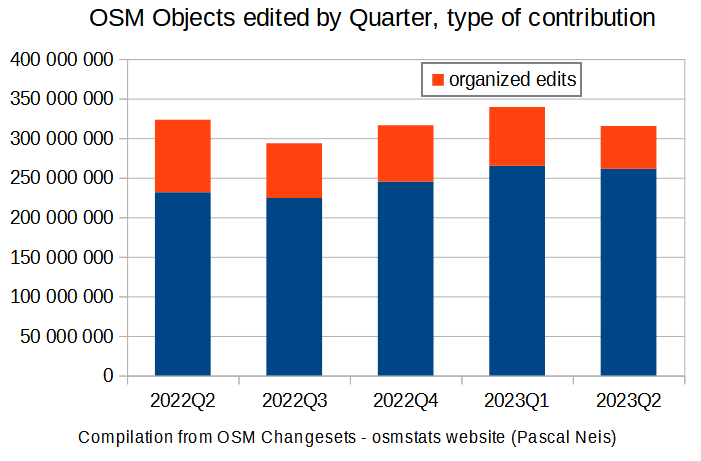
As illustrated on graph 1, there was a small decline of OSM objects edited during this period from 323 millions objects edited in 2022-Q2 to 314 millions in 2023-Q2. This decline comes from the Organized editing with 92 millions objects edited in 2022-Q2 to 54 millions in 2023-Q2 (his share from 28% to 17%).
Graph 1
Organized edits Trends by Continent

To start editing OSM, a new user needs to go through a cluttered registration form.
At the same time, vandals easily register thousands of new accounts.
One vandal with an army of bots can paralyze the work of hundreds of mappers in an instant.
At the same time, only the gradual careful work of one person can correctly correct a damaged map.
The project is 19 years old, it’s time to grow up.
Posted by amapanda ᚛ᚐᚋᚐᚅᚇᚐ᚜ 🏳️⚧️ on 21 August 2023 in English.

Hi all, I’ve made a website which shows how all the waterways in OSM are topologically connected, or not:
More details are there, or on the backing github project. You can also run the programmes for yourself if you want to tweak it, or just show your region.
This tool can help you find possible tagging mistakes in river topology, like change in a name, or find places where 2 rivers aren’t properly connected up.
Data is updated manually by me when I remember.
What do yous think?
You can follow me on fedi/mastodon @amapanda@en.osm.town for news, or read this on the Discourse OSM Community Forum
I have just realised I should have been adding ‘survey’ as a source in basically all my edits over the last week or so.
I’ve been using RapidEditor to create buildings, matching them with my notes as I walk around exploring my new neighbourhood.
🤦

If you’re not aware, a massive number of accounts have started removing name:ru tags from objects worldwide. Over 4,600 accounts have already been blocked as of the time of writing. I want to bring this situation to the attention of the OSM community that might not use the community forum/discord/etc. and doesn’t know what’s going on.
I don’t really know what to say about this situation or a solution, but it hasn’t been mentioned on-site yet. I hope OSM finds some way to deal with mass-account vandals because mass blocks + detection don’t seem like a sustainable solution, especially with changeset comment abuse, notes abuse, private messages abuse, etc. - the fact that this could happen in the first place is problematic.
(from OSM Discord)

(from OSM Discord)
We are lucky this person is “only” removing Russian names, not something more critical
-snoozingnewt
After an unfortunate setback in 2020 the 14th in-person State of the Map conference will be held in Africa for the first time, underlining OSM’s status as a truly global map. Long may our commitment to going round the world to experience what we are mapping continue.
I’ve never heard complaints from the many people who attended Foss4g and the HOT summit in Dar es Salaam and I am confident that Nairobi can be a similar success.

This diary is about how the Divide and map. Now. is deployed.
Divide and map. Now. consists of multiple parts like server, JavaScript clients, JOSM plugin or web page. Each part is clearly separated and has its own repository. All are integrated within the damn-deploy, which has its own repository, too.
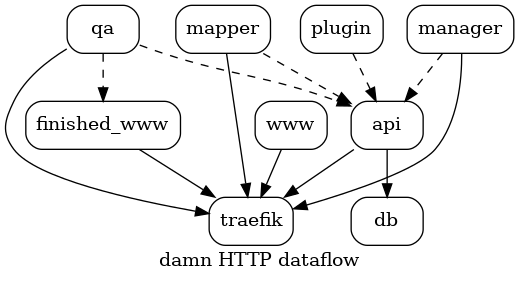
I am not a sysadmin. When I worked on the refactor deploy, I kept Docker and Systemd and Debian. I simplified dockerfiles, removed unnecessary ones, removed unused SQL code, added systemd units and rewrote the “How to deploy” and “How to upgrade” in the README.
I added damn-www-template with the hugo static site generator, simple blogging theme and an example content. If you care to run your own instance, you may get inspired. But don’t get limited – only a dockerfile serving your web page is expected.

Over the past few days, my perspective on OpenStreetMap (OSM) has undergone a seismic shift. For the longest time, I held OSM in the highest regard, viewing it as a beacon of transparency and people-centricity amidst a sea of profit-driven tech conglomerates.
Chapter 1: The Banner of Surprises
My view started to waver a couple of days ago when a new donation request banner popped up on the main OSM page. Though its sheer size and prominence were unsettling, the real issue lay in the near-invisible close button. When I voiced concerns on its ready-for-production state, opposition awaited me on the other end. Was this a shift in OSM’s priorities?

Chapter 2: The Amazon Alliance
This entry was meant to test this Diary feature.
Sorry for the clutter.

Hello everyone, I am here again with the 5th Blog of my journey as an Outreachy intern. For those who don’t know me , I am Neelima Mohanty , selected as an Outreachy intern at Humanitarian OpenStreetMap Team (HOTOSM) for the May to August Cohort. If you are new to my blog then make sure you read my previous Outreachy Blogs before going through this blog post.
This is the second last week of my Outreachy internship and I almost feel like I am a part of the HOT Community or in other words I feel like I know many members of HOT already. Apart from my mentors Rob Savoye and Petya Kangalova , the list of members whom I know are Kshitij Raj Sharma , Omran Najjar , Susmina Manandhar and Sam Woodcock . Informal chats with all these people made me more familiar with this community. Let me introduce all of them with you and what I have learnt from the informal chats with them.
Kshitij and Omran are part of the dev team for fAIr project of HOT . I learnt a lot from each one of them about backend and frontend of that project and understood their work to implement AI in the process of mapping .
I already have written about my interaction with Sam Woodcock in my 2nd Blog . But that was how we came to know each other for the first time . Whereas when I got selected as an Intern , he sent me a message introducing himself and told me that he would like to help me in my technical documentation work in FMTM if I face any issues . Then I came to know that he had been volunteering for FMTM since a long time.
And finally and very recently I met with Susmina Manandhar from Nepal who work as an Associate Project Manager at NAXA one of the partners of HOT . We together worked for two weeks and prepared the Lightning Talk Video of the FMTM project for Code for All summit. While in these two weeks , we met almost everyday and not just talked about work but she also shared about herself and her University days .
OSM is ChAozsz.
OSM is like an unprincipled anarchist society.
OSM is like an anarchic society with a broken system.
OSM is an anarchic society of absolute equality that has collapsed
Who can resuscitate the OSM ecosystem?
I had mapped my first mass path a little over two years ago and made a video about it: https://www.youtube.com/watch?v=JyxYRqNG6aI. I’m revisiting the topic now for reasons I will get into.
What is a mass path?
In Ireland, mass paths are either footpaths people used to walk to church or - more often - to school (because the school tended to be very close to the church). Those mass paths are basically short cuts across fields and were used until the 1960s or thereabouts. The other type of mass path dates back to the times of the Penal Laws, when Catholics were forbidden to go to mass (and to school). They met at secret locations, mass rocks or mass pits, to celebrate mass. The went out of use with the end of the Penal Laws.
Why my re-awakened interest?
My local county council had wanted to start a project to record mass paths in the county, and I considered applying for it, but I could not meet their conditions (driver’s license, insurance). This was regrettable, because I could have assembled the perfect team, but it was not possible for us. However, thanks to determination and OpenData platforms like OSM and Wikimedia, it doesn’t mean we can’t record some of them.
Methodology
Today I spent half the day in the forest near Bahrdorf to prepare an orienteering map in OOMapper. First I downloaded the OSM data into the app, then set out with a tablet computer as well as fieldpaper, pencil and compass to add all the features necessary for orienteering. There are of course lots of details to attend to, but I want to write about the role of OSM in orienteering mapping today.
For a forest map that I set up from scratch, OSM data come in handy because they provide a georeferenced basemap to start from. But other than that, 99% of the orienteering map is my work, and there is not much in what I do that is of interest for OSM (except the odd information board or a path that has disappeared).
Things are quite different when it comes to sprint orienteering maps, which mostly show parks and urban areas. The availability of OSM data was a real game changer here, because we used to draw all the building outlines by hand. For a quick training map, there is a webservice that renders OSM data in an orienteering map design and lets you download the map as a nicely styled pdf. Of course, this map will only contain the features that are present in OSM and cannot be edited further, so I still prefer to use the OOMapper app with downloaded OSM data, so I can add whatever features I need for the orienteering map - and more than a few of them will also be useful in OpenStreetMap.
The biggest question here is: do I add the features after downloading from OSM, or before? One the one hand, since OSM data helped save such a lot of time, it seemed only fair to give back. Moreover, if all orienteering features of a specific area were present in OSM, I wouldn’t have to bother about map backups, and every interested orienteer could download a decent o-map from the webservice mentioned above.
So this is what I brought me to OSM. Needless to say, today I spend far more time on OSM mapping than on mapping for orienteering.

North America has a lot of streets that go “straight north and south”.
This presents a difficulty because once a road’s azimuth goes left of due north, its labels must flip to avoid becoming upside down (as the street continues curving.)
This is not usually a problem with straight parallel streets, as all will be left or right of due north, thus their labels will all either read all upwards or all downwards.
So why do the labels on Brown Avenue, in Evanston, IL USA flip back and forth, disturbingly different than its neighboring fellow north-south streets? (See osm.org/way/23392043 and inspect its avenue name at different zoom levels.)
Ah ha, because it wavers sightly back and forth over true north! Let’s check those azimuths as we go along it:
wget https://www.openstreetmap.org/api/0.6/way/23392043/full
perl -F\" -awnle 'next unless $#F==18; print "@F[-2,-4]"' full |
  sort -k 2n | gmt mapproject -Aof -o2
NaN
1.34312351808
1.4347131823
0.581553728998
-0.40040076319
-0.406099373288
0.930238524534
0.595013044226
1.17968994378
Anyway, “you got to draw the line somewhere” for when to flip lettering, so it’s at true north. Adding some “AI fuzz factor” would probably just complicate algorithms.
Artificial terrain modeled after natural terrain (자연 지형을 본 따 만든 인공 지형)

What’s this for?