 OpenStreetMap
Posted by umbraosmbr on 2 September 2023 in English.
Location:
Centro, Curitiba, Região Geográfica Imediata de Curitiba, Região Metropolitana de Curitiba, Região Geográfica Intermediária de Curitiba, Paraná, South Region, Brazil
Diary Entries in English
Recent diary entries


The Standard Tile Layer has a lot of traffic. On August 1st, a typical day, it had 2.8 billion requests served by Fastly, about 32 thousand a second. The challenges of scaling to this size are documented elsewhere, and we handle the traffic reliably, but something we don’t often talk about is the logging. In some cases, you could log a random sample of requests but that comes with downsides like obscuring low frequency events, and preventing some kinds of log analysis. Critically, we publish data that depends on logging all requests.
We query our logs with Athena, a hosted version of Presto, a SQL engine that, among features, can query files on an object store like S3. Automated queries are run with tilelog, which publishes files daily to generate published files on usage of the standard tile layer.
As you might imagine, 2.8 billion requests is a lot of log data. Fastly offers a number of logging options, and we publish compressed CSV logs to Amazon S3. These logs are large, and suffer a few problems for long-term use because they:
- contain personal information like request details and IPs, that, although essential for running the service, cannot be retained forever;
- contain invalid requests, making analysis more difficult;
- are large, being 136 GB/day; and
- become slow to query, being compressed gzip files with the only indexing being the date and hour of the request, which is part of the file path.
To solve these problems we reformat, filter, and aggregate logs which lets us delete old logs. We’ve done the first two for some time, and are now doing the third.

How do we better organize to support the Humanitarian OpenStreetMap Team organization, staff, membership, and community? We have been on a journey to open up and consider what is the best way forward for HOT’s Governance. Now that we have the HOT Living Strategy, we have more incentive to imagine how we might evolve. We are taking stock of our governance and investigating how we might be able to encourage more people to engage in the governance of HOT.
The HOT Governance Working Group (GWG) started the process of research and engagement with the HOT membership in January 2023. We’ve documented this process in the GWG meeting minutes. Together we designed a terms of reference to hire support to help us research some initial bylaw adjustments and wider organizational needs and structures.
Our first big research is exploring how we govern with the board and to better support the membership chair. There will be future steps and research to consider the role of the membership and how we collaborate with the Open Mapping Hubs.
The board and membership asked us to consider the following topics: the possibility of appointed board members, board member stipends, and membership chair term. See the current HOT bylaws
Why the proposed changes
The HOT voting members have a wide range of skills, and have brought much insight and change to the organization. Currently, HOT’s board is elected from and by the voting membership. Over the past years, HOT board and organization have identified gaps in key expertise for the board, including legal, finance and large-scale fundraising. This has been documented in various OSM diary posts, the HOT board election discussions, and the Board and GWG meeting minutes.
Posted by lhirlimann on 29 August 2023 in English.

Last week I had a week of vacation in beautiful Greece. As I needed to do some kind of daily exercise, I decided to walk and played with streetcomplete. I’ve been off the app for a few months due to lack of motivation.
After one hour of going around and adding things I looked at my profile and was #1 on Greece what a shock.
Wondering how that could be?
- Are all greeks using iphone? (I doubt)
- Is no one using OSM in Greece? (I doubt)
- Is Streetcomplete missing some greek translation (probably, I didn’t check).
- Am I the only one doing streetcomplete while on vacation?

OSM에는 왜 이렇게 흐릿한 갈래가 많을까……
외국 사람들에게 한국의 ‘곰’, ‘탕’, ‘국’을 갈래지으려면 갈래지을 수 있을까?
도대체가 말이 안 되는 짓거리를 언제까지 하고 있을 건가…… ㅡ.ㅡ
Why does OSM have so many fuzzy branches……
Is it really possible to make Korean ‘gom’, ‘tang’, and ‘guk’ forked for foreigners?
How long are we going to keep doing this nonsense…… ㅡ.ㅡ

I am contributing to OpenStreetMap because I want to make the world a better place by adding verified information.

Hello! Today, I want to share a handy script that can enhance your experience with JOSM on MacOS by enabling a dark mode theme. Dark mode not only looks sleek but can also reduce eye strain, especially during late-night mapping sessions.
Note: This script is specifically for MacOS users.
Step 1: Download JOSM
If you haven’t already, download the latest version of josm-tested.jar here. Save it to a location on your Mac.
Step 2: Install the FlatLaf Plugin
FlatLaf is a fantastic plugin that allows you to apply dark themes to Java applications. After installing the plugin and restarting, go to the menu and select the dark theme: JOSM → Settings → Display → Look and Feel → FlatLaf Darcula
Step 3: Create and Run the Script
Now, let’s create a script that will launch JOSM with a dark theme. Open your favorite text editor and paste the following code:
shell
#!/bin/zsh
java -Dapple.awt.application.appearance=NSAppearanceNameDarkAqua -Xmx7168m -jar /Users/YourUsername/Documents/josm-tested.jar
Make sure to replace YourUsername with your actual MacOS username. This script does the following:
-
#!/bin/zsh: Informs your system to use the Zsh shell to execute the script. -
java -Dapple.awt.application.appearance=NSAppearanceNameDarkAqua -Xmx7168m -jar /Users/YourUsername/Documents/josm-tested.jar: Launches the Java runtime with dark mode enabled, allocates 7168MB (or 7GB) of RAM to JOSM (you can adjust this value), and specifies the path to your JOSM JAR file.
Step 4: Save and Make the Script Executable
Save this script with a .command extension, for example, josm-dark-mode.command. To make it executable, open your terminal, navigate to the directory where you saved the script, and run the following command:
shell
chmod +x josm-dark-mode.command
Step 5: Execute the Script
Now, you can simply double-click josm-dark-mode.command, and JOSM will launch with a beautiful dark theme, thanks to the FlatLaf plugin and the MacOS appearance setting.
Posted by Sarabjeet Sodhi on 28 August 2023 in English.

Introduction
Hi everyone, this is my final report for my GSoC’23 project: support Vespucci preset extensions in JOSM.
Previous diary entries
Project Summary
About the project
Vespucci utilizes the JOSM preset format but has extended the configuration to work better outside of the narrow realm of JOSM. The project aimed at adding these additional extensions in JOSM. These extensions include deprecated, regions, exclude_regions, value_type, and alternative. see Vespucci preset documentation
Work done
The presets can have the additional attribute “regions”, which will contain the ISO codes of the countries to which the preset is applicable. “exclude_regions” will invert the meaning of “regions”, i.e., the preset should not be applied in countries specified under “regions”.
A warning message is displayed before the upload if the preset is applied in the country not defined in the “regions”.

It has been just over a week that I have accomplished the 365 daily MappingChallenge (Mastodon) and decided to persist with a 100 weekly challenge instead. One of the main (Mastodon) reasons is how daily contributions are being processed based off of UTC+0, which is manageable if one does not travel. Further this week I have decided to use the OSM Diary over Mastodon, since this way I can do long form entries with less constraints and possibly reach a larger audience.
Quick overview
In week 54:
- 34 change sets created in total
- 5327 node changes in total
all were done within JOSM.
Changes
- extracting sidewalks from roads
- splitting up schools
- adding roof shape and roof material
Puchheim Realschule and Gymnasium
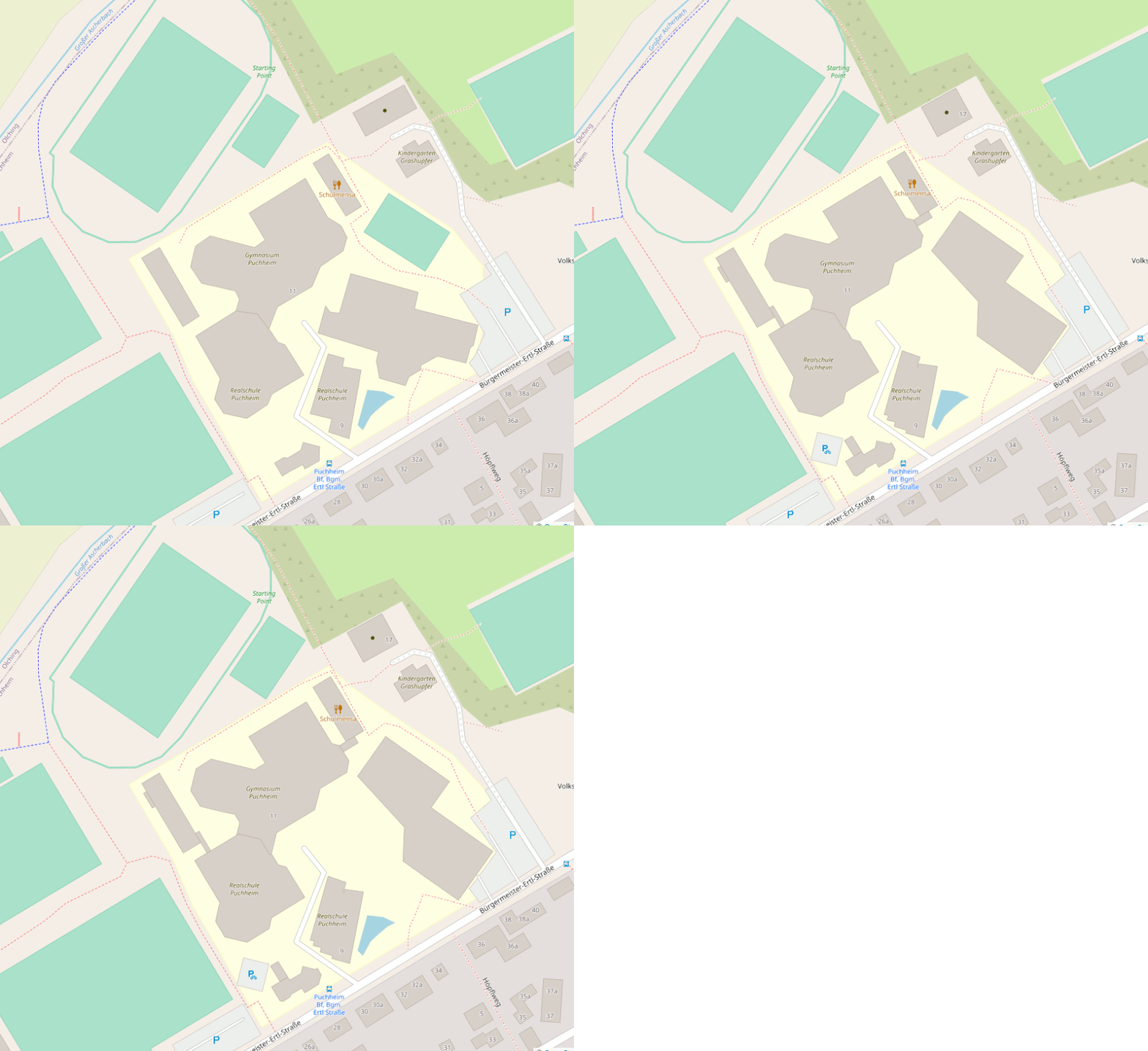
Puchheim Mittelschule and Grundschule

Heritage Week is an annual number of days (it’s longer than a week by now) taking place in August in Ireland. There is a wide array of events including talks, workshops, guided walks etc all around built and natural heritage. This year’s topic was “Living Heritage”.
Recording Milk Churn Stands
Early on in my effort to map milk churn stands in Ireland, I thought that it was not sustainable for me to travel around the country and look for the needle in the haystack, when the locals knew where all the milk churn stands were. So I decided to give a talk which would hopefully raise awareness about the endless possibilities OpenData, OpenSource and OpenStreetMap offers. It was supposed to be a workshop, but I had a funny feeling that the demographic of the audience would turn it into a talk. It actually turned out to be the first event on the Heritage Week website. The Minister for Heritage (, Housing & Electoral Reford) who I happen to be friends with offered to attend, and of course I thought that would be a great opportunity to promote OSM.
The venue was a library in a rural town which used to have a creamery, because I thought it might attract people who remembered the time when milk churn stands (aka creamery stands) were still in use. Once the librarians heard that the minister was attending, they got a bit excited and let the regional library manager know. The big day arrived on August 16th, and he did attend. I had brought the OSM Ireland pull-up poster for the photo op, and also for branding awareness reasons. - So many people still don’t know about OSM, even though everyone by now must have been exposed to it one way or another.
Hi everyone,
I am thrilled to present the final updates on my ongoing project focused on enhancing the search experience in Japan. For reference, you can find the previous blog entry here and the interim report here. In the last interim report, I introduced the changes related to the sanitizer. The associated pull requests for these changes can be accessed here. Regarding this article, you can find the pull request for this specific change here.
In this final update, I will provide detailed insights into our efforts in the “Address Search” realm, specifically related to the tokenizer.
Enhancements in Address Search Methods in Japanese
Japanese Addresses are written in one large string without spaces and Nominatim needs help to find the words. As an illustration, for instance, consider the Japanese address “東京都新宿区西新宿2丁目8−1”. Although it lacks spaces, it can be divided into internal segments such as “東京都” (similar to a state or district), “新宿区” (akin to a city), “西新宿” (akin to a town), and “2丁目” (a block). However, Nominatim only divides such addresses using ICU (International Components for Unicode) transliteration, not based on this semantic division. Fig.1 illustrates a debugging example with multiple potential candidates.

Project name: Guidelines for mapping of wetlands and floodzones. Case study of Lower Sinu river basin in Caribean region of Colombia
Description
The goal of the project is to test the mapping case study to build a document with guidelines for mapping in this areas. It comes from the experience of the “Water telling stories” Social Movement, a root social initiative of near 47 communities, grassroots organizations from 5 municipalities around the ecosystem of the Lower Sinu River Basin, located in the north coastal side of the Cordoba Department, in the Caribean region of Colombia. As part of the technical support team of the movement, Iḿ leading the mapping project for this area.
I used the jamboard to put one the difficulties from my side:
“I can’t find allies for my legacy project from my OSM local and regional Community. I need people to help me to identify the needs of mapping wetlands and flood areas.”
I’m working with one volunteer from Youth mappers in Colombia who is interested in help to this mapping project. As I said in my diary entry, previously I had lead one mapping session to invite people to join our tasking manager mapping task to map Bajo Sinu “Lower Sinu River basin”.
In my action plan I have:
Summary of the situation

Current mapping is inadequate. I have some idea how to make it better, but I am not so sure just yet.
Southern junction
You will smiling, but yes. Again vandalism. Thousands of obscene names have been added to the map. Entire cities were flooded with offensive expressions. I have never seen so huge vandalism.
I thank everyone who worked on solving this problem. You do the good job. Thank you very much.

I found myself down a rabbit hole searching for a good tool for a specific use-case today. The use case is trying to send someone a link to a specific geographic area. My use-case was for directing another person to a specific meetup spot (“meet me over here by the northeast corner of the parking lot”), which doesn’t need to be a point but could be something like a 10x10 foot square and still get the point across. Additionally, there’s a use-case for it in leaving “map notes” within the OSM system: some notes need to indicate very precisely “there’s a missing feature RIGHT HERE”, but others could be more general (“this area is a forest”), and if the note could be tied to a zone, that could be more helpful.
I have used what3words in the past for this, and that site has a nice, short URI scheme to share with people, but the map layers don’t include OSM options, so I started looking for ways to combine the two. That lead me to the wiki page that highlighted many shortcomings with that system (as it’s a centralized, copywritten service). So I went hunting for other systems that could fill the same need of sending people a nice link to “meet me here” (small area) or “I live here” (building-sized area), with OSM tile data under it.
Of the many options for “geohash”-style approximations of latitude/longitude, it seems “Plus Codes” (formerly “Open Location Codes”, OLC) have gained traction as a way to refer to small and large geographic areas, but the main https://plus.codes/map site (the key one that allows seeing a visualization of the grid system, so you know how big a region you’re referring to) only uses Google Maps tiles as the underlying visual, so aesthetically is the same as what3words (telling someone “meet me at the corner of the parking lot here:” with https://plus.codes/86MG4JJJ+HHR is essentially the same experience as giving them https://w3w.co/handy.lame.treats).

Since a few month, uMap has been integrated in a French state incubator, so things are moving quite a lot!
uMap is now ten years old, and is deployed on many instances around the world. The one I know well is hosted by OSM France, and is close to reach one million maps created and 100.000 users.
This incubation program is ported by the French “Accélérateur d’initiatives citoyennes”, it includes coaches and a small budget for non tech needs (UI/UX…). One goal of this program is to find financial support for uMap development and maintainance. A French administration, the Agence pour la cohésion des territoires, is the first uMap financial backer since a few months. This allowed us to put up a small team to work, part time, in uMap:
- two devs: David Larlet and myself
- a UX designer: Aurélie Jallut
- a bizdev, which is yet to hire (interested ? Contact me!)
That’s great news! Until then, uMap was 100% developed on my spare time.
uMap is used a lot by French public agents, and this explains the support from the French state, to make this tool better, and more official. For this, a first step is an “official” instance for public workers:
https://umap.incubateur.anct.gouv.fr/fr/
We’ll be at the NEC - Numérique En Communs event (Bordeaux, France), on October 19th and 20th. See you there for more news and announcements!
What’s new in uMap, then ?
First, a huge cleaning, upgrade and bug fight in uMap code. Since a few years, my time available for uMap has been very low (I’ve been a baker for two years…), so the code urgently needed more love.
What else? Here are a few of the notable changes made recently in uMap, let’s go!
Docker image
Finally!
Village and union council

Corner store
State of the Map Brasil 2023
O State of the map Brasil ocorrera nos dias 02 a 04 de Outubro de 2023.


Hello everyone, I am here again with the last Blog of my journey as an Outreachy intern. For those who don’t know me , I am Neelima Mohanty , selected as an Outreachy intern at Humanitarian OpenStreetMap Team (HOTOSM) for the May to August Cohort. If you are new to my blog then make sure you read my previous Outreachy Blogs before going through this blog post.
Just 3 months ago I received an email at my inbox from the Outreachy organizers according to which I got selected as an intern at Humanitarian OpenStreetMap Team for the May to August 2023 cohort . And look today my internship is going to end in just two days . So I planned to take you all into a rollercoaster ride of my internship journey .
In the first month I was welcomed by my mentors Rob Savoye and Petya Kangalova where Petya introduced me about the HOT Community . Next I was assigned with many github issues from the projects FMTM and osm-fieldwork by my mentor Rob . I still remember Rob saying me “ Don’t get overwhelmed by seeing the number of issues assigned . Just pick one and start working now and you don’t have to complete all . Take your time and complete only as much as you can comfortably” . These words were so relaxing for me .
Throughout the months of June and July , I and my mentors worked together . I created PRs and they reviewed it , left comments . I worked on them and finally they merged them . One great thing that I always liked and appreciate is that Petya and Rob always respond quickly to my messages and Rob reviews my PRs in seconds in the most perfect way . I also worked with other members of HOT like Kshitij and Omran for another HOT project called fAIr.
In the last month of my internship Petya and Rob offered me an opportunity to be a co-speaker at the Lightning Talk for the FMTM project at Code for All Summit which I accepted and completed . It will be released on 20th September 2023 on Code for All You tube channel and social media handles. Do watch it .