osm.org/way/332402058#map=18/51.04571/3.73169&layers=D has been changed to Zelenski lane.
Sorry about the date, 00:00 means to me the next day.
 OpenStreetMap
osm.org/way/332402058#map=18/51.04571/3.73169&layers=D has been changed to Zelenski lane.
Sorry about the date, 00:00 means to me the next day.
Welcome to my third OpenStreetMap NextGen development diary.
This week has been super busy and I can’t wait to show you the progress 🧑🍳!
You can subscribe to my diary updates on RSS here:
osm.org/user/NorthCrab/diary/rss
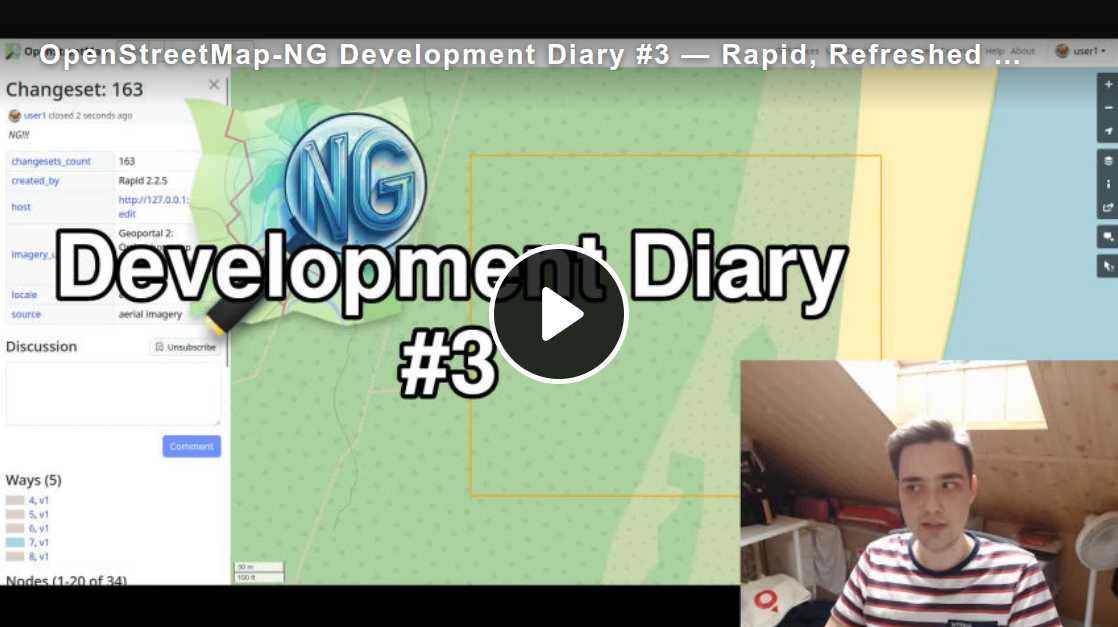
This week I was focused on integrating features together, as we get closer and closer to the first development release. I am super happy with how things are progressing and I decided to record a short video presentation (3 minutes).
⬇ Click below to play ⬇
or click here: https://peertube.monicz.dev/w/kGnomi7LTveXZNaaQtEwH6
Hello,
I just wrote a blogpost about campsite tagging in OSM on my blog.
Here is the URL: https://blog.geggus.net/2024/03/the-state-of-campsite-tagging-in-osm/
Please comment here if you like.
Currently I am developing and maintaining a website for the district of Jeli (not official) that provide information on places in the district. I wish that I can implement for others to add the information too but I am too afraid of someone abusing the function to do malicious things.
-
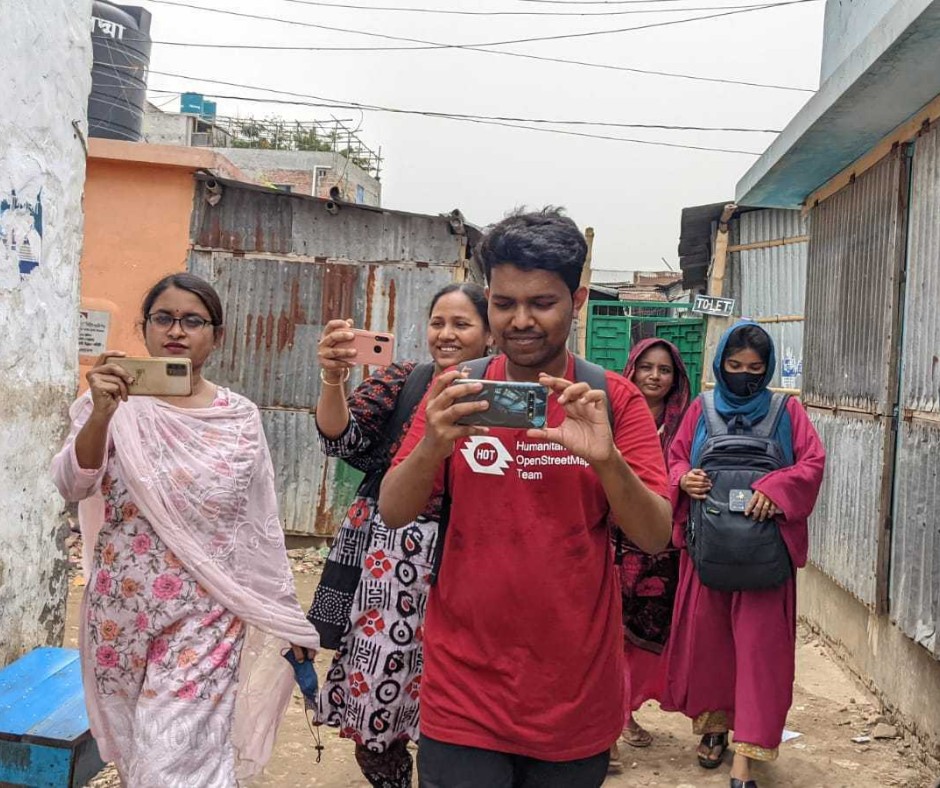 Open Mapping Guru, Brazil Singh in a field visit and data collection in Mirpur and Duaripara, Dhaka.
On Thursday 21 March 2024, I received invitation from Open Mapping Hub Asia Pacific & also brilliant Mikko Tamura, Community Manager for Asia and the Pacific at Humanitarian OpenStreetMap Team, for the coordination of OM Guru for Dhaka Field Visit & Data Collection. I was so much exited, and I accepted the invitation instantly. And then I got the news about the guests who are coming to Bangladesh and they were Can Unen, Senior Manager for Community & Partnerships, Humanitarian Openstreetmap Team , Honey Grace Fombuena, GIS AnalystGIS Analyst, Humanitarian OpenStreetMap Team and Harry Mahardhika Machmud, Senior Program Manager for Asia-Pacific at Humanitarian OpenStreetMap Team
I was lucky enough (or maybe deserving) to have been granted one of the GoPro Maxes sponsored by Meta, a project organised by OSM Belgium - many thanks for that!
I’ve had it for a week now, and I’ve been very busy with it - around 12.643 images captured so far (some nearly duplicates I deleted and some without GPS data I didn’t bother adding it to). I don’t drive, so I only went about on my bike and on foot - so far, but I would like to try it on a car roof at some point.
My first stop was St. Mullin’s in Co. Carlow, a small village, but more importantly early Christian monastic site and National Monument. There is a relatively new bus route (887 Local Link) going there which hadn’t been mapped yet, so I took the bus from Carlow to St. Mullin’s to track the route and bus stops. The bus driver was kind enough to tell me where the bus stops were, because for most of them, they are not signposted. (Trace 1 and Trace 2, if anyone is interested, but the routes are mapped so far) Mapillary shot of bus at Carlow Train Station at unsigned bus stop
I am Bayazid Ahmed. I am from Bangladesh. I am studying at the Eastern University of Bangladesh. I am a joint secretary of our chapter, YouthMappers at Eastern University.
Hello, OpenStreetMap Community!
We at Mapilio are thrilled to announce a significant update that’s been in the works for some time now — the integration of our imagery layers into OpenStreetMap, available through the iD editor. This collaboration represents a milestone in our ongoing commitment to enhancing the mapping experience for everyone in the OSM community.
 ## Why This Matters
The power of OpenStreetMap lies in its community and the collective effort to create the most detailed, open-source map of the world. By integrating our high-quality imagery layers from Mapilio, we aim to empower mappers with even more tools to enhance accuracy and detail in their mapping endeavors.
♪♫ When Girls Just Want To Have Fun ♫♪
On March 23, 2024, as part of the Women’s Month celebration, the Viscan YouthMappers organization conducted a mapping activity titled “MapaBabae: When Girls Just Wanna Have Fun Mapping the Streets Using Mapillary.” This initiative aimed to pave the way for women’s empowerment through mapping, celebrate the contributions of women in the field of mapping, and inspire each other.

It started with an introduction of mine about what the Mapillary is all about which will be used by us by updating the streets of our University Campus that hasn’t been captured last mapillary event. Sharing that Mapillary is a collaborative street-level imagery platform wherein participants in MapaBabae are able to document their journeys and highlight points of interest, and share their stories regarding about this acivity. At its core, MapaBabae is about more than just mapping streets; it’s about creating a community where women feel seen, heard, and valued.
English below / Português abaixo
Il y a presque cinq ans, lors du SotM 2019 de Heidelberg, j’avais présenté une analyse critique du concept de mapathon sous le titre de « Mapathon Mapathon Mapathon ». L’historique du concept rappelait combien il s’agissait au début de projets menés sur plusieurs jours, pour devenir ensuite ce que j’ai appelé le mapathon 2.0, une action de cartographie collaborative sur imagerie dans une durée qui s’étend rarement au-delà de deux ou trois heures, avec des objectifs variables, au-delà de la donnée produite : promotion du projet OSM, engagement ou renforcement communautaire. communication sur un projet ou la structure organisatrice de l’événement…
Je ne pense pas que ce format 2.0 ait évolué depuis, mais il y a un aspect que j’avais identifié à l’époque sans pour autant le développer : le mapathon 2.0 en tant que forme privilégiée pour former de nouveaux contributeurs et contributrices OSM.
On pourrait penser qu’il ne s’agit pas d’une rupture avec le passé, mais plutôt d’une suite assez logique de la manière de former de nouvelles personnes à OSM avant l’avènement des smartphones, qui dans mon souvenir se sont démocratisés au Sud à partir de 2015 environ (voir ce graphique de l’International Telecommunication Union). Toute contribution dans OSM se faisait alors forcément en salle, vu que les moyens de collecte sur le terrain (terminaux GNSS classiques type Garmin Etrex ou cartes imprimées de type Walking Papers ou Field Papers) nécessitaient une reprise des données brutes du terrain sur ordinateur avec son éditeur préféré.
The Magdalen Islands (Îles-de-la-Madeleine) are an archipelago located in the center of the Gulf of Saint Lawrence (Eastern Canada). The heart of the archipelago is made up of seven rocky islands connected by long sand barriers, sand spits, dunes, and salt marshes. Including internal lagoons, the islands cover about 330 square km. The archipelago is sparsely populated and counts about 12K permanent inhabitants.
In June 2023, OSM describes the islands’ coastline, road network, some trails as well as some human and natural features. Overall, the islands were mapped using about 56K nodes, 5K ways, and 116 relations (Figure 1).
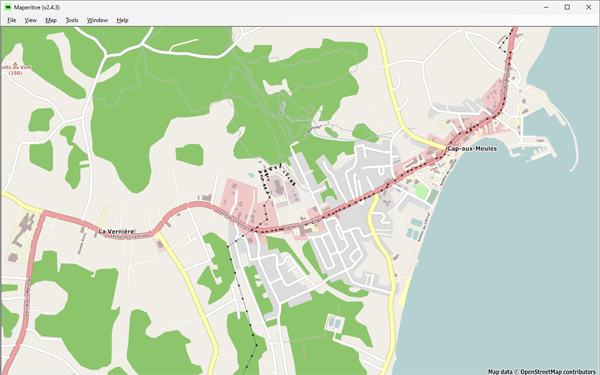 Figure 1: Cap-aux-Meules, before starting the project—Historical OSM data as of June 30, 2023, on Maperitive.
not been lazy but busy with so many other things, but got suddenly a new JOSM install fit for use an got catched for a few hours by now: I read some old wiki docs from 2008/09 i. e. the pilot work for Karlsruhe house number tagging schema in our town, added a few obviously missing objects, peeked into current issues nearby on Osmose did some corrections - all that feels good, this might even start a new series of contributions. :-)
[deleted]
What is this why is there a diary
Hi again,
It’s just 2 days before this diary post was published, and I’m very happy to announce that I will start proposing tags again. I already have exciting ideas and hopefully the community approves them.
EDIT: Next proposal will hopefully come tomorrow or this week, stay tuned!
Ewrt1
A few months after my graduation, I find myself questioning how prepared I am to face the real world. Will the knowledge I acquired in school, particularly regarding organizational management, truly benefit me? Or could OSM mapping play a pivotal role in shaping my career path?
Through mapping activities, I've gained critical thinking, problem-solving, and collaborative skills—qualities highly sought after in today's job market. Little did I anticipate that within these communities, I would uncover aspects of myself previously concealed. Leadership, once abstract, found a nurturing environment within the supportive ecosystem of YouthMappers. It was here that I discovered my capacity to lead, inspire, and effect change.
YouthMappers became my haven for personal development more than merely a platform. With every mapping project, my confidence increased. Although it was scary at first, public speaking became a skill I developed whenever I got the chance. Our community's response to our influence extended well beyond the boundaries of our maps, creating a lasting impression on people's emotions.
These days, certificates appear on my résumé as credentials as well as proof of my experience. They talk about the hours spent creating, learning, and working together. With the support of mentors and the friendship of other mappers, I learned things that went beyond what was found in textbooks.
Today, I stand not just as a graduate, but as a leader forged in the crucible of YouthMappers. I have the privilege to educate others on utilizing OSM mapping for change. Once reticent, my voice now brims with the fervor of someone who has experienced the potency of unity in action.
Welcome to my second OpenStreetMap NextGen development diary. I am ready to highlight this week’s progress — and there was a lot 👷!
You can subscribe to my diary updates on RSS here:
osm.org/user/NorthCrab/diary/rss
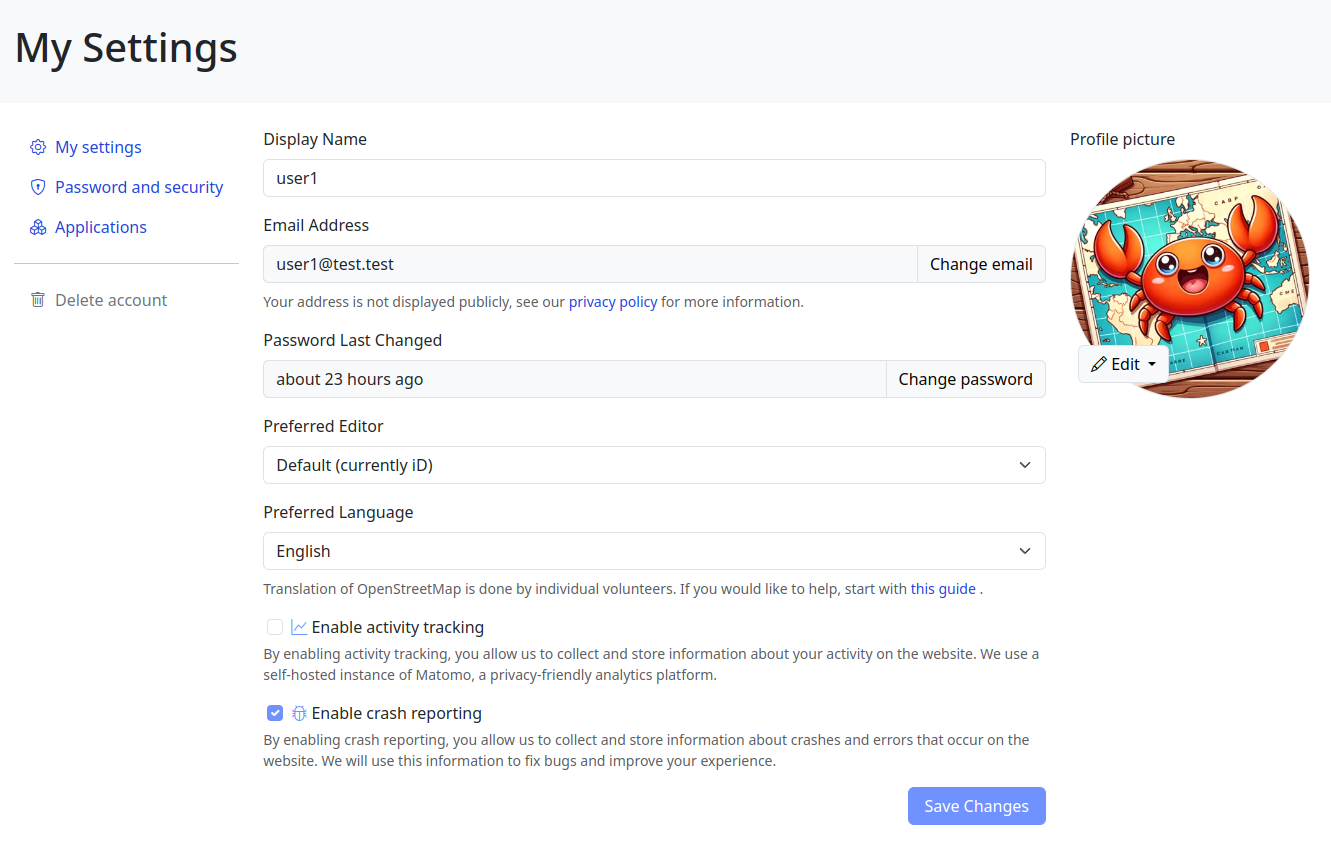
Last week I showcased initial progress on the new settings page for OpenStreetMap. This week, I’ve finished it. Here’s what’s new. Keep in mind that if you believe some features should be done differently, there will be a period of public testing where I’ll collect this kind of feedback 😉.
Click here to view it in full screen.
Aside from the improved layout, I’ve introduced two notable changes. First, the application language selection has been redesigned; it’s now a simple dropdown selector. I believe the current system (where you input locale names by hand) is difficult for less technical people to understand, and I want to make the website more accessible to everyone!
Participants shaded by umbrellas, to protect them from the sun, while collecting fresh geodata with FieldPapers. UP Mindanao Campus, Davao City. Photo shared by UPMinYouthMappers in their SNS post.
While visiting the family down south, I had a chance to join UP Mindanao’s own chapter, UPMin YouthMappers while their College (of Science & Maths) was celebrating Pi Day. The coordinator asked if I have any preference for the name of the activity we had in mind, and I suggested Map-Pi Day.
I’ve been kind of bouncing around various projects the past week.
I have tentatively completed sidewalk mapping in Emsworth Borough, and have moved on to adding sidewalks and pedestrian crossings in Avalon. I also did a little revamp of the playground adjacent to the Avalon Elementary School. It turns out that as I was extending the sidewalk along California Avenue, I met up with some previously mapped sidewalk bits, which is nice. Although they have not added a lot of the tags I do, so I will circle back to make this area a little more seamless with what I’ve added to the west.
I’m planning to go through Ben Avon and Emsworth to tag pedestrian crossings and curbs a little more consistently; I had been changing the way I tag things as I went based on new information/methodology.
I got kind of distracted when I realized that Pittsburgh Botanical Garden needed some updating due to their recent renovations. I was able to add the new visitor center and update a lot of the concrete paths, but I have some question marks as to the accuracy of some of the other paths on the property. I will take some good GPX tracks the next time I am there (likely this week). I especially want to see what progress has been made on the feature that is to the southwest of the Lotus Pond. I will also try to acquire a more precise/accurate/official property map from PBG, because the pictoral one on their website is great for ordinary wayfinding, but wholly inadequate in precisely showing where things are.