OpenStreetMap logo OpenStreetMap

Diary Entries in English

Recent diary entries

A few weeks ago, I wrote a plugin for PMTiles for JOSM. PMTiles is a web-first tile storage format which allows the provider to have a single file with all the tiles they want to share. Users can then make direct requests using HTTP Range Requests to get just the data they want. With this, other OSM users have discovered that they can run a tile server for <2 USD/month.

As of Aug 28, 2023, the JOSM MapWithAI plugin now supports PMTiles and Mapbox Vector Tiles as data sources. Please note that no tag transforms are occurring, so if you do use the data, please use the replacement tags feature of the plugin. With that said, it is theoretically possible for a pmtiles file to give us the mappings; the specification has a JSON metadata field which can have arbitrary key value mappings.

Anyway, here are some known datasets to test out this functionality (I only tested the overture-pois.pmtiles file):

As a reminder, there is a reason why the overture data has not been imported into OSM, mainly quality concerns. So if you do use it, ensure that whatever it is you are adding actually exists (for POIs) or is geometrically correct (for buildings/roads).

See full entry

Location: Grand Junction, Mesa County, Colorado, United States
Posted by umbraosmbr on 12 September 2023 in English. Last updated on 13 September 2023.

The activation of Flood Mapping in the City of Muçum, RS has begun!

As a result of the rains that affected the state of Rio Grande do Sul, Brazil, UMBRAOSM, the Brazilian Chapters of YOUTHMAPPERS created an Activation project for mapping in the city of Muçum in the state of Rio Grande do Sul - Brazil for mapping the City! !

This project aims to map buildings, so if you want to use the MapWithAI tool (Rapid or JOSM), it is recommended to use this tool mainly in rural regions with low building density. This allows you to quickly add AI-predicted buildings and roads. However, human verification is necessary. Don’t just accept auto-detected buildings - ensure correct building alignment, geometry and road classification before saving your work.

If you want to use JOSM, you must download the [MapWithAI] plugin (https://github.com/KaartGroup/JOSM_MapWIthAI_plugin#readme). The plugin wiki page contains detailed usage instructions. You can also use the [building_tools] plugin (osm.wiki/JOSM/Plugins/BuildingsTools), which will make the geometry creation process easier. Once the building has been digitized, use the “q” key to adjust the geometry. For road mapping, remember that they must be connected to each other. Additionally, generate enough nodes to avoid sharp angles when changing road directions. In the case of intersecting roads, an intermediate node must be placed at the point where they intersect, unless there is a structure separating them, such as [bridges] (osm.wiki/Key :bridge) or [tunnels] (osm.wiki/Key:tunnel).

Powered by:

Umbraosm Brazilian chapters of youthmappers HOTHubLAC Brazilian Community of Openstreetmap

See full entry

Posted by GiftedIsha1 on 11 September 2023 in English.

I honestly don’t have the words to describe the overwhelming flow of emotions that I am experiencing regarding this project.

*This a whole new experience for me and I feel so blessed to be apart of this program and would honestly recommend anyone in joining and learning about the values and endless opportunities that exist with using (OPEN STREET MAP). From the first hand experiences in my community to mapping specified areas in my country it is such a remarkable experience for the young and young at heart to widen their horizons and try new things.

Location: Jamaica
Posted by aman_bagrecha on 10 September 2023 in English. Last updated on 11 September 2023.

On September 9, 2023 Let’s Talk Spatial and OSM Bengaluru organized a mapping party in Chamrajpet, Bengaluru, India. We had 367 contributions to OpenStreetMap with 6 first-time contributors. After we finished mapping, we were #1 in the world in terms of number of edits!

photo1

The idea of organizing an outdoor mapping activity originated on the day when OSM celebrated its 19th Birthday. My social media was flooded with mappers celebrating in various different ways to show their love towards OSM.

On the last day of FOSS4G I saw mappers mapping the streets of Prizren - noting down the opening hours, contact details and much more information onto OSM. Though I missed the opportunity to map with them, I saw this could be done in my city, with the help of expert mappers.

See full entry

Location: Shankarapuram, Chamarajapete, Bengaluru, Bangalore North, Bengaluru Urban, Karnataka, 560004, India

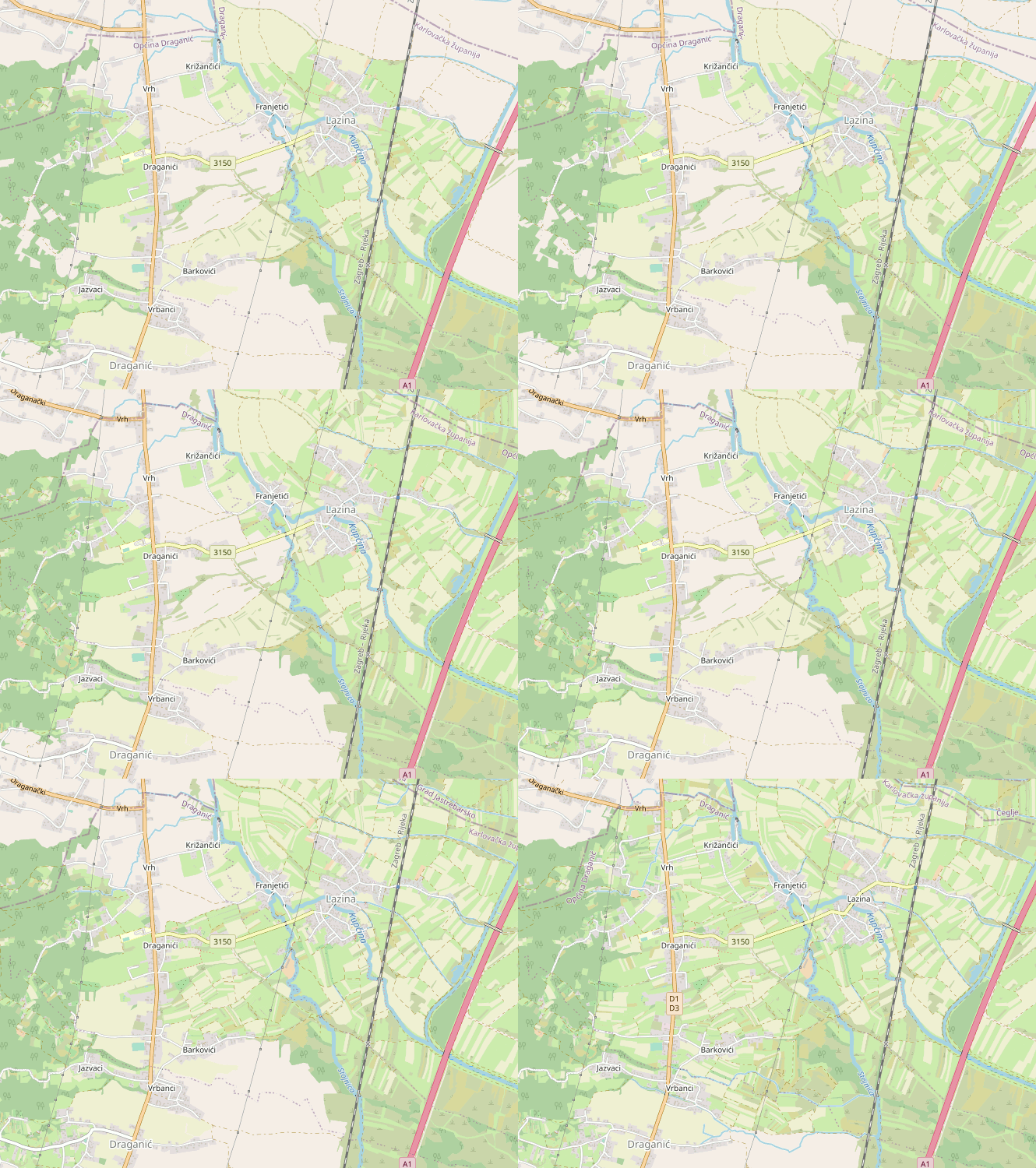
This week continued working on the barefootstache-mapping-croatia project to align with my upcoming trip to the area.

While mapping east of Vrbanci, I noticed that I was almost done with its boundary and completed it.

before and after animation of OpenStreetMap depicting land cover addition mainly farmland, meadow, heath, scrubs, wood, and many other land covers

Quick Overview

See full entry

Location: Lazina, Mjesni odbor Lazina - Franjetići, Draganić, Municipality of Draganić, Karlovac County, 47201, Croatia
Posted by pedrito1414 on 9 September 2023 in English.

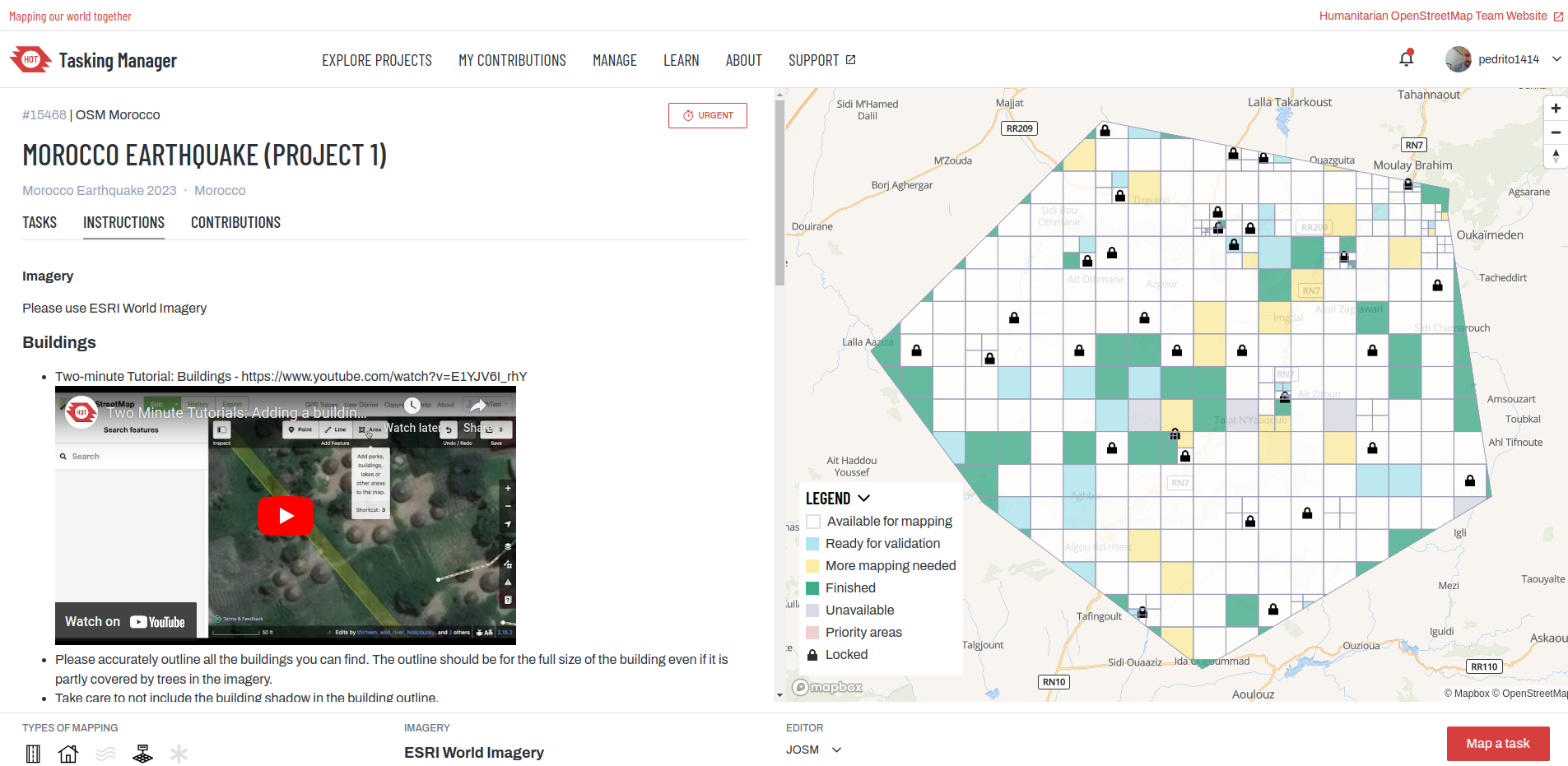
Following the earthquake in Morocco last night (08-09 Sept 2023), staff from HOT’s West and Northern Africa Open Mapping Hub and OSM Morocco agreed to launch an activation to support response efforts.

If you would like to support by mapping, please do. The first project is now on the HOT Tasking Manager and more will follow.

HOT Tasking Manager

You can also keep track via the activation wiki page : 2023 Morocco Earthquake.

If you have questions or would like to engage, you can do so via the HOT slack or the OSM community forum.

Thanks in advance for your time and skills in support!

Posted by Black_Diamond on 8 September 2023 in English.

The USGS 3D Elevation Program (3DEP) is awesome. When mapping roads, creeks and trails that are covered by trees, it’s nearly impossible to use any satellite imagery in any meaningful way. Even if someone spends the time to use GPS to track a road or hiking trail, it is even harder to find someone to walk down the middle of a lot of creeks to track the path of the water flow. It’s also not uncommon for the GPS trace to be off by several feet or even have gaps in the data near tall dense trees, which reduces the accuracy of the path being traced on a map. 3DEP can help in such situations.

three dimensional elevation program (3DEP) Logo

I believe that this data is only available for most of the US territories. So if you are mapping outside outside of the US, this may not be beneficial to use.

See full entry

Posted by prispe on 8 September 2023 in English.

On the 6th of September 2023, we the members of the committee had a review on the volume of applications submitted by the applicants for SotM Africa which is slated to be held in Cameroun this year 2923. Letters were sent to the applicants whose application was not successful.

On the 8th, we concluded were 15 of the applicants made it to the top. Letters will be sent to them by the 9th of September, 2023.

Make a Donation to UMBRAOSM Union of Brazilian OpenstreetMap Mappers and keep the site in AR and your projects!

https://www.umbraosm.com.br/doacao.html

These are the data to send a Pix to the Neon account!

To send by keys: Email: umbraosm@gmail.com

Name: Roberto Borges De Sousa

See full entry

When I started getting involved in mapping on OSM around July 2021, I asked myself: “But why hasn’t anyone made a guide to help me map this country?” and indeed, there was no specific guide to contribute on North Korea!

North Korea Mapping Guide

Beginning

After learning and integrating all the basic OSM tags (including highway=*, building=*, natural=*, landuse=* etc.) and mapping some small towns of the country, I thought about creating a personal page of recurring tags for easy retrieval.

Then the idea came to me to make a thematic page on the contribution specific to this country.

Access to the terrain in North Korea is complicated, and a good understanding of satellite imagery is essential, so a guide to the subject becomes all the more relevant. So I decided to create one!

See full entry

Location: Otan-dong, Central District, P'yŏngyang, North Korea

Revised Script for usage in macOS 12+ with zsh:

#!/bin/zsh
echo "Download"
wget -t0 -c "http://download.geofabrik.de/europe/andorra-latest.osm.pbf"
wget -t0 -c "http://download.geofabrik.de/europe/austria-latest.osm.pbf"
wget -t0 -c "http://download.geofabrik.de/europe/belgium-latest.osm.pbf"
wget -t0 -c "http://download.geofabrik.de/africa/canary-islands-latest.osm.pbf"
wget -t0 -c "http://download.geofabrik.de/europe/czech-republic-latest.osm.pbf"
wget -t0 -c "http://download.geofabrik.de/europe/denmark-latest.osm.pbf"

echo "Convert"
./osmconvert --drop-version andorra-latest.osm.pbf -o=andorra-latest.o5m
rm -rvf andorra-latest.osm.pbf
./osmconvert andorra-latest.o5m -o=merged.o5m
rm -rvf andorra-latest.o5m

for FILE in ./*.osm.pbf; do ./osmconvert --drop-version $FILE -o=$(basename $FILE .osm.pbf).o5m; ./osmconvert $(basename $FILE .osm.pbf).o5m merged.o5m -o=merged_cache.o5m; rm -rvf $(basename $FILE .osm.pbf).o5m; mv -v merged_cache.o5m merged.o5m; done

echo "splitter" 
## latest splitter Version r653 used
java -Xmx5G -jar splitter-r653/splitter.jar --output-dir=tiles --max-nodes=1200000 merged.o5m

echo "mkgmap"
## latest mkgmap Version r4910 used
## template 2022pn.typ used, use what you like :)
java -Xmx5G -jar mkgmap-r4910/mkgmap.jar --country-name=OSMMap --family-name="OSM map" --product-version=1 --bounds=bounds-latest --dem-interpolation=auto --make-poi-index --poi-address --unicode --index --split-name-index --gmapsupp --report-routing-islands -c mkgmap-r4910/examples/sample.cfg -c tiles/template.args 2022pn.typ --style-file=../ --check-styles --route --net --gmapi --add-boundary-nodes-at-admin-boundaries

echo "final clean up"
rm -rvf *latest.o5m
rm merged.o5m
cd tiles
rm -rvf *.osm.pbf
cd ..
rm -rvf 6*.img 
rm -rvf ovm_6*.img

echo "The End"

Tree mapping is a task that is better done in person than using aerial imagery, unless it is a tree row. The reasoning being that node placement of natural=tree is more precise than looking from above, since more often than not the imagery is not that clear.

Trees tell a story

When looking at this area it is fascinating how one can make out man made structures relative to the placement of trees.

trees and tree rows as nodes and ways in JOSM

Further once adding the leaf_cycle and leaf_type one can create shade maps that could be practical during heat waves like at mapasdesombra.org or if jveuxdusoleil.fr extended its algorithm to include tree details as well.

One can add the tree’s height and diameter with a check date to create a timeline of the tree’s lifespan, though also add more potential data points in ecological terms.

Or one can add the genus and/or species to ease the search for foragers like mundraub does with their overlay map.

Tree specification

See full entry

Posted by qeef on 3 September 2023 in English.

The damn deploy repository of the Divide and map. Now. has been refactored. And that’s a great opportunity for another round of load testing.

This is the third round of load testing, see the first and the second one if you are interested.

The load testing is a bit different from the last time. I performed load testing of new, freshly deployed damn project instance on $6/month VPS with 1 GB RAM, single 2.5 GHz vCPU, and 25 GB SSD. (The changes from the last time are that there is no more load testing of the “production” server, the price increased by $1/month, and shared_buffers is now 256 MB instead of 409 MB.)

The preparation for load testing on the server’s side, when the damn project is deployed, is just to run

docker-compose -f damn-deploy/gen.yml run --rm prepareloadtest

to create 1000 test users and 10 (load) testing areas in the database. For each run of load testing, the database has been deleted and created again with

systemctl stop damn-http.service
reboot
docker volume rm damn-deploy_damndb-volume
systemctl start damn.target
docker-compose -f damn-deploy/gen.yml run --rm prepareloadtest

commands. For each run of load testing, log the server’s utilization with

sar -o load-test-100 -A 15 $((4 * 61)) 1>/dev/null 2>&1

Then, from that file, you can generate data series and plot the graphs with

./get-info.sh 100
gnuplot plot1.pl
gnuplot plot2.pl

where the content of the corresponding files is

get-info.sh:

See full entry

Posted by scruss on 3 September 2023 in English.

… unless you want a greatbighuge label inexplicably hovering over the map at z=16.

Looking over this fine city of Toronto, I saw a couple of brown labels for places that are sort-of not real. Exporting and grepping local exports showed me they were landuse ways with a name value set.

I’m sure there are plenty of good examples where a landuse area would have a name. In these cases, though:

  • one was the name of a city/developer study from roughly five years ago that has disappeared from the record since then. Will it become a neighbourhood name? Who knows, but that’s for the future and not for us to force. (fun fact: it’s apparently the densest concentration of office workers in the city. Less fun but very Toronto fact: there is no dedicated transit there. I had a job there ~2006–2008 and new transit was planned, but then the trainwreck formerly known as Mayor Rob Ford happened so it didn’t.)

  • one was a drive-by tagging error by an out-of-band specialist. I really think they meant it for a bus stop.

Aligned with my personal policy of “Only kvetch after fixing”, they’re gone and our z=16 will be so much less jarring. Thank me later.