OpenStreetMap logo OpenStreetMap

Diary Entries in English

Recent diary entries

About HIFLD

OSM power user SherbetS has been documenting the HIFLD dataset. It is a large corpus of public domain licensed geospatial information about infrastructure around the United States.

Get all the data into JOSM

Download the dataset in GeoJSON format here. Fire up JOSM and open the file. This will create a layer that is just the HIFLD data. If won’t have any fields that look like OSM fields so DO NOT upload this directly.

Next we need to get the OSM data into JOSM. For this demo we will use the data for the state of Wyoming.

  • Click the green download button to open the Download dialog.
  • Click the “Download from Overpass API” tab at the top.
  • In the Overpass text box put something like:
// fetch area “Wyoming” to search in
{{geocodeArea:Wyoming}}->.searchArea;
// gather results
(
  // query part for: “amenity=hospital”
  nwr["amenity"="hospital"](area.searchArea);
  // query part for: “amenity=clinic”
  nwr["amenity"="clinic"](area.searchArea);
);
// print results
out body;
>;
out skel qt;
  • Hit the “Download into new layer” button at the bottom

We now have 2 layers. One with the HIFLD data and one with the OSM data.

Finding unmapped items with the conflation plugin

We will now use the Conflation Plugin to match the nodes in the HIFLD dataset with OSM downloaded elements. Any elements that do not match to an OSM item should be reviewed and additions made. Any matched elements may be reviewed for completeness in OSM but that’s a separate matter.

We will start by selecting elements from the HIFLD dataset that are in our state of interest (“WY” in this case) and add this to the Conflation tool as the “Reference”. This is the set we’re trying to match elements to.


See full entry

As there have been lots of updates recently, I’ve made a new release of all of the code behind map.atownsend.org.uk

There are releases for four repositories - the lua code that does all the hard work, the map style that determines what it looks like, the map legend, and the website for the map itself.

Here’s a summary of what’s new:

Natural features

Rocky features are now shown in more detail:

See full entry

Location: Seamer, North Yorkshire, York and North Yorkshire, England, United Kingdom
Posted by SK53 on 13 April 2023 in English.

For a number of years I have sporadically looked to resolve missing speed limits on major highways (highway=trunk and highway=primary) in the UK. I use a simple Overpass query to find these in a manageable area (usually former regions of England + Wales, Scotland and Northern Ireland.

The other day a discussion arose on IRC about some distinctly English placenames in North Wales. Looking at the area I realised that the A493 had no speed limits added. As both Mapillary and now Bing Streetside imagery are now available in the iD editor, I was able to add limits from Aberdyfi to Tywyn. In the past this nearly always required a survey.

I was going to write about looking at limits elsewhere, but found it easier to add various pictures in a short Mastodon thread.

tl;dr: There’s lots of work everywhere to improve the mapping of maxspeed on highway=primary.

Location: Aberdovey, Gwynedd, Wales, United Kingdom
Posted by KAWAMALA on 11 April 2023 in English.

Hello World!

Not a new word to you right?, so do the contents…

In the past few years I have been organizing and conducting Mapathons or Mapping Parties as known to many of you, through that experience I have been able to develop this guideline to help individuals and organizations towards organizing successful Mapathons, I know it is not easy and always an overwhelming process but exciting when it goes right, HahaH, recently at Ardhi University, Dar es salaam, Tanzania I conducted a Mapathon, It was no joke, 60+ alumni, students, and OSM community members joined forces to learn the ropes of mapping and networking, facilitated by @rootgis

We couldn't have done it without the amazing support from HOT ESA HUB and the Spatial People Network program , thank you so much for the funds and resources to make it all possible!

During the mapathon Buildings, Roads , Land Use and Point of Interests were mapped and all data generated were added to OpenStreetMap (OSM).

Wow, talk about a productive day! >>Fast Forward

Therefore...

A mapathon is an event where brothers and sisters come together to map a particular area for a given purpose few of them being Refugee Response, Disaster response, Transportation, Disaster Preparedness, Public Health, Water & Sanitation, Sustainable Cities, Agriculture, Poverty Elimination, Environment, Gender Equality, Clean Energy, OSM Community, Disaster Recovery, you mention it.

The goal of a mapathon is to create accurate data and maps that can be used for humanitarian, development, Refugee Response, Disaster response, Transportation, Disaster Preparedness, Public Health, Water & Sanitation, Sustainable Cities, Agriculture, Poverty Elimination, Environment, Gender Equality, Clean Energy, OSM Community, Disaster Recovery

So what to do when planning for a successful mapathon ?:

See full entry

I’d like to note a few things that are rather inconvenient when working with this setup.

Firstly, this causes neck pain! When I’ve got my camera mounted and recording, the combination of the extra weight plus the aerodynamic profile make this camera very cumbersome on the neck. you will notice right away a mild pain in the back of your neck.

Secondly, dropping. I’m pretty clumsy, and after a good ride I come home and start taking everything off, primarily the camera off the helmet right away to alleviate the pain. I haven’t got a good place in my garage to set the camera down, so I hold it awkwardly while I try to open my bike crate, camera box, etc. and put things away. Twice now I’ve dropped the camera on the ground, and the first time it scratched the main lens pretty bad, and the new mark is visible on the newest photos I’ve taken.

Unfortunately, I haven’t had the tools for any superior camera mounts. My bike isn’t very conductive of temporary stick mounting, and all the selfie sticks I have are of a less than satisfactory length to use as a standalone system. I’ve thought about mounting it to a backpack like I used to do with my old LG360, but that suffers from lots of shake and insecure mounting. tying down all the straps on my backpack still made the stick wobble, and made it very inconvenient to work with.

I’ve also recently had an issue with the version of OsmAnd that I’m using, the latest version has a glitch that makes the currently recording track disappear if the start point isn’t on the screen. https://github.com/osmandapp/OsmAnd/issues/16947

All that aside, it still is rather easy to set up, and it’s not difficult to ride around for an hour or so and get some footage quickly.

Posted by cartofy on 6 April 2023 in English. Last updated on 2 May 2023.

The OSM Urban Road classification guidelines for India dictate a number of high-level directions on mapping roads in Indian cities. When Devdatta and I tried to fix some classifications in Pune, we realised that the current guidelines don’t provide a solid base for decision making, in an “if X, then Y” way. So we decided to observe, annotate, experiment and retrospect on whether a classification makes sense.

We realised that to map a road, one must understand how a road is perceived, and its purpose in the larger scope of the neighbourhood, locality or city. This gives the road a purpose, and that purpose defines its classification. The purpose or intent of the road is not enough to classify it, so we tried to observe a few other factors that characterise roads in major Indian cities. Here’s what we found.

  1. Much like a river, a road begins somewhere and merges into another road. As roads connect with each other, the larger road essentially “collects” traffic from a smaller road. However, it is not necessary that a smaller road feeds into a larger road. Often, it might feed into a road of the same size, but with elevated purpose.
  2. Some roads serve the same purpose but could vary wildly in their characteristics, including the width of a single lane.
  3. Many collector roads can be easily identified using tell-tale signs such as the presence of speed bumps, traffic signals and dividers.

The observations led us to try and categorise roads based on a few factors:

See full entry

We know from the pilot HOT unSummit programme that we need a better name (too many people thought it referred to the United Nations!)

Can you help us think of one?

Cuauthémoc putting up an event banner at a geography student conference in Mexico

It need to encapsulate one, some or all of the following aspects…

  • It is a programme that supports / collaborates on open mapping-relevant events all over the world
  • The objective is to inspire people and give them the means to take collective action on humanitarian / social problems through open mapping and OpenStreetMap
  • It seeks to expand and strengthen the humanitarian open mapping movement
  • It is supported by / powered by HOT, but in collaboration with many communities and organising committees

Once we have a new name, we will update the branding and the next phase of the programme will relaunch in June.

See full entry

Let’s recap some work done on the damn project.

Divide and map. Now. – the damn project – helps mappers by dividing a big area into smaller squares that people can map together.

As outlined in Work for 2023, I have been working on the improvements to the web clients. The consequences are better clients and easier deployment (which is not yet documented). Also, I have restructured and slightly rewrote the https://damn-project.org/ web page.

Changes to the web clients

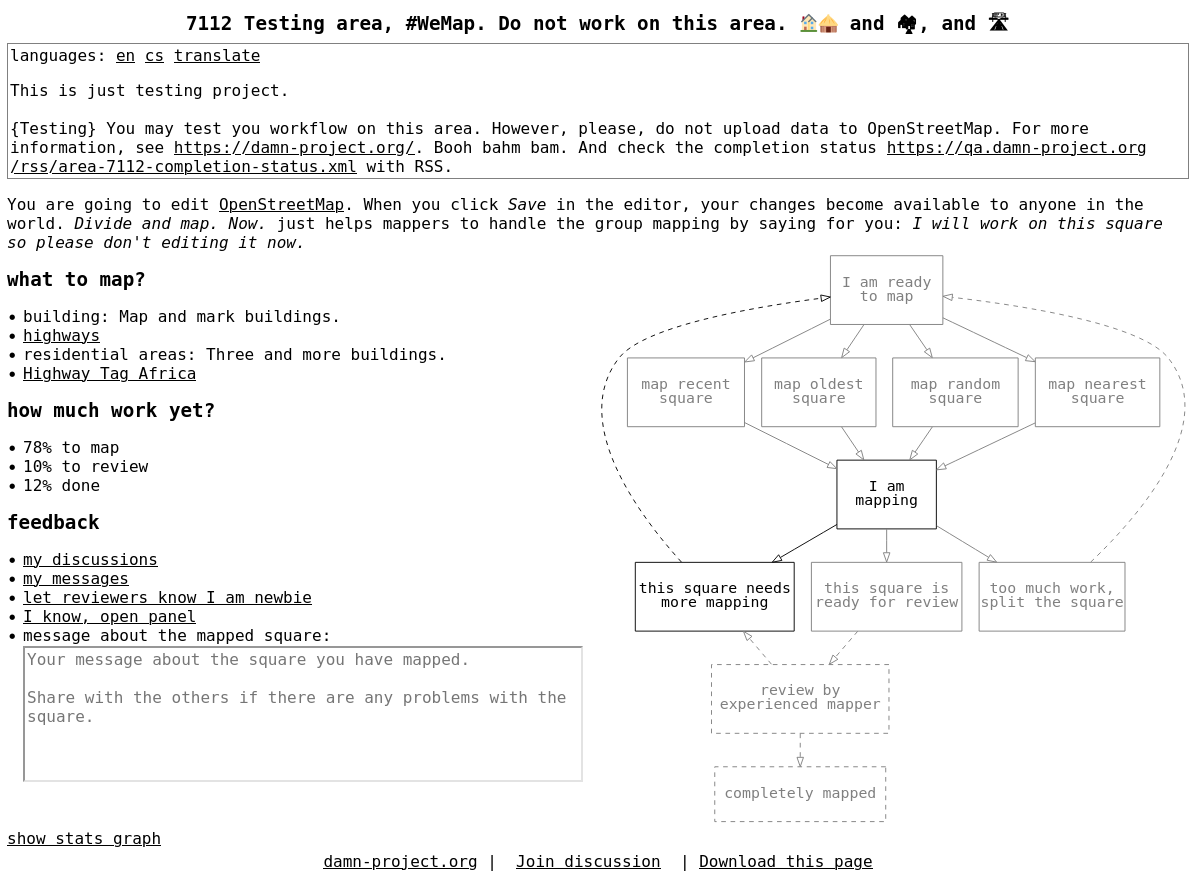
New client for beginner mappers is out, see mapper. I was thinking of how to better describe map-review-done workflow. The original client has “Show mapping square workflow diagram” showing ASCII art square’s state flow when clicked. I had and idea to show SVG figure (generated by dot) instead of ASCII art, because it is easier to generate, maintain, and translate. SVG is text, too, so I can bare that. But wait! SVG is HTML element, isn’t it? So it’s clickable, isn’t it? So it can be done interactive, can’t be?

Mapper web client of the damn-project.org

See full entry

Posted by mvexel on 3 April 2023 in English.

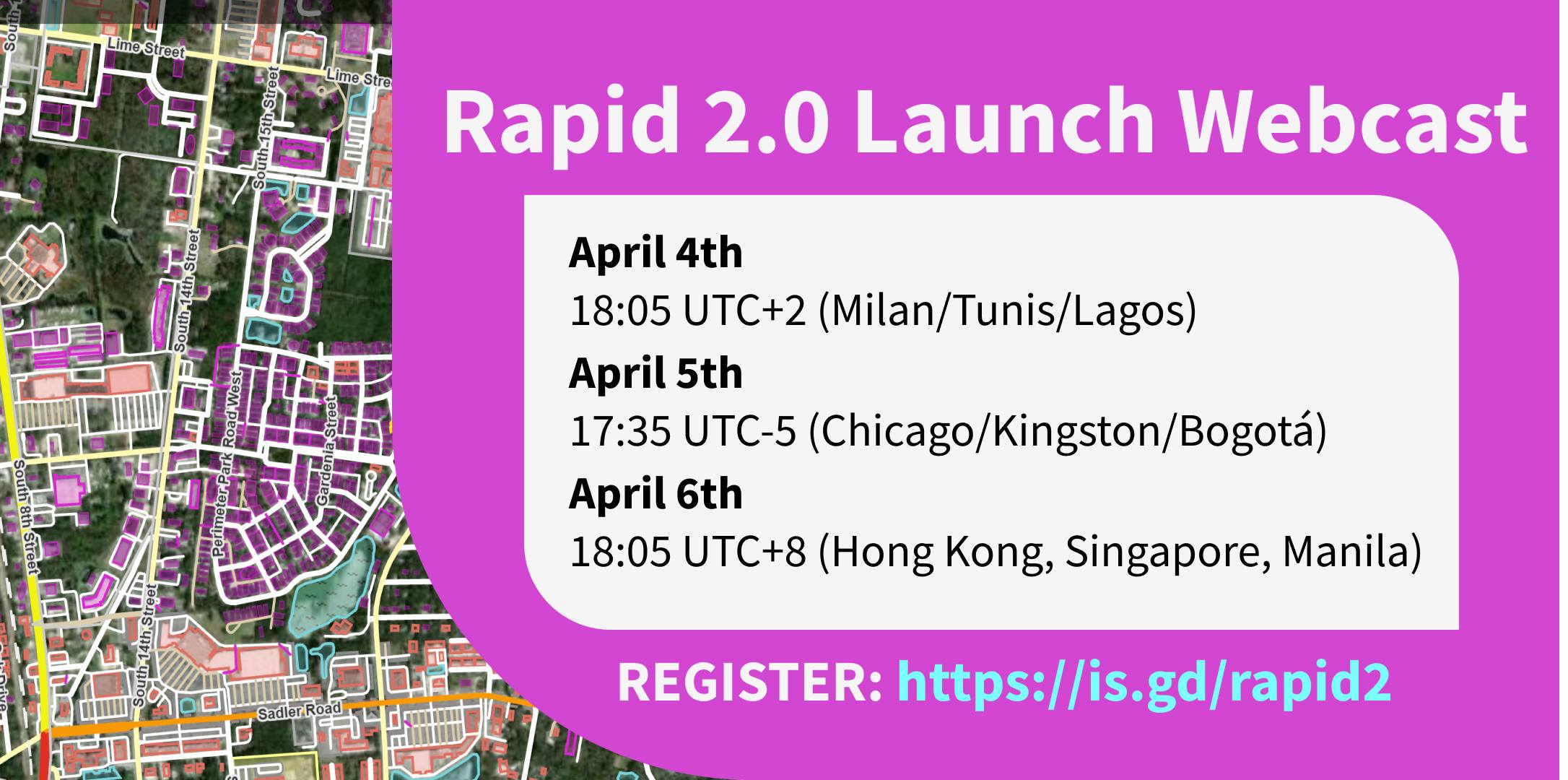
Rapid 2.0 launches this week. The Rapid team will host webcasts on April 4 (tomorrow at the time of writing), April 5, and April 6 for Europe / Africa, the Americas, and Asia / Pacific timezones respectively. You can sign up here. You can expect an overview of what’s new, and a live demo. You will also be able to ask the Rapid team questions.

Rapid webcasts promo

What’s new

I wrote about the public beta of Rapid 2.0 before, and covered what’s new there.

One additional thing I wanted to call out is the ever-growing amount of external datasets available to mappers for efficient mapping of addresses, buildings and other features available as open data. There is a page on the OSM wiki that lists them all, and Esri has an interactive map with all the data sources available and considered as Rapid layers.

See full entry

Location: Rapid City, Pennington County, South Dakota, United States
Posted by chris_debian on 3 April 2023 in English. Last updated on 4 April 2023.

Ok, following on from my earlier writing, I can confirm that I have installed and tried capturing data with both the SmartRoadSense and Roadroid Android applications, on my Pixel 6. Both apps had good points, and ‘areas for development’. I was only able to capture data, submit it, and see it on a map, with Roadroid. My understanding is that I can’t do this with SmartRoadSense, because the app infrastructure is currently dormant, due to EU funding coming to an end, but I understand from the devs, that they are about to reinvigorate the project.

Lars Forslof (Roadroid) is doing some excellent work with his propriety solution, but I think the nature of his objectives, are business oriented, and enables a ‘customer’ to request survey coverage for a defined area, which is then coordinated, at a financial cost.

My main questions/ thoughts now, are:

  1. Is road surface data useful to anyone? I would suggest it is useful for deciding on routing, and can be used under open source terms, to enable interested bodies, such as highway/ local authorities to have an initial understanding of where surfaces don’t meet a required standard.
  2. Is OSM the right place to record the values?
  3. Can the open source community encourage the good people at SmartRoadSense to work with us, or do we need to create a new app, with infrastructure? The algorithm used to process the data is currently closed source. My preference would be to work with SmartRoadSense, and have a backlog of potential improvements, hosted on GitHub https://github.com/SmartRoadSense
  4. Encourage interested users to install the SmartRoadSense APK, and to give feedback at the GitHub address. The app didn’t appear in Play Store, in the UK on a Pixel 6, so I’ve used APK https://m.apkpure.com/smartroadsense/it.uniurb.smartroadsense
  5. I will write to the SmartRoadSense devs, to highlight these thoughts.

What is needed (Requirements capture)? (MoSCoW)

M= Must Have S= Should Have C= Could Have W= Won’t Have

See full entry

OSM supports really complex opening times, apparently.

This node, a roof-top bar in Stratford, London is opening on the 20th of April. The following are the opening times per their website:

  • April 20th to April 30th : Thursdays to Fridays 5pm- 11pm, Saturdays-Sundays 12-11pm
  • May 1st- May 14th: Wednesdays to Fridays 5pm- 11pm, Saturdays-Sundays 12-11pm, Bank Holidays 12-11pm
  • May 15th- end of September: Tuesdays to Fridays 5pm- 11pm, Saturdays-Sundays 12-11pm, Bank Holidays 12-11pm

The opening_time value I came up with is this:

Apr 20-30 Sa-Su 12:00-23:00; May-Sep Sa-Su 12:00-23:00; Apr 20-30 Th-Fr 17:00-23:00; May 01-14 We-Fr 17:00-23:00; May 15-31 Tu-Fr 17:00-23:00; Jun-Sep Tu-Fr 17:00-23:00; Oct-Dec off; Apr 20-30 PH 12:00-23:00; May-Sep PH 12:00-23:00

It also helped that there exists a handy tool that can visualise complex opening_time values.

I am looking forward to seeing how OSMAnd handles this when it eventually gets the updated node.

Hi all! I’m writing this new post to show a recent mapping that I’ve done on an industrial facility. In this case, I worked on a crucial headquarters of Petronas International, located near Turin (between the municipality of Santena and Villastellone).

The facility has been in that place for a long time but in the recent year the company built here the new global research centre so, under the pretext to add the new building, I mapped with care the facility.

That the result of my work:

Before

Facility before

After

See full entry

Location: Petronas Lubricants International, 1, Villastellone, Torino, Piedmont, 10029, Italy

To support organizations that use OpenStreetMap data for disaster response, the HOT Data Team is strengthening our data quality and fitness measures.

Several teams at HOT, including the Data Team, Technology & Innovation Team, and the Regional Hubs, are collaborating to develop resources, tools, skill sharing, and community feedback mechanisms that will be avenues for data creators and data users to collaborate to improve OpenStreetMap data quality.

Data Team:

The HOT Data Team presented the top 10 data quality issues in a lightning talk at State of the Map 2022 in Florence. We categorize these data quality issues into three main categories:

Semantic Accuracy

  • Tagging
  • Tasking Manager project consistencies

Positional Accuracy

  • Spatial offsets
  • Feature tracing inconsistencies
  • Logical consistencies of map features

Completeness

  • Temporal inconsistencies
  • Road network inconsistencies
  • Completeness of health facilities
  • Completeness of public service data for sustainable communities
  • Administrative boundaries

The Data Team is also defining use cases and data quality metrics. Measuring data quality starts with identifying core datasets for each of our impact areas. Examples include highways and health facilities for Public Health, water & sanitation, transportation, and education for Sustainable Cities & Communities, and waterways, buildings, and highways for Disasters & Climate Resilience.

We then evaluated the use cases and the metrics for assessing the quality of each dataset, enabling us to identify ways of improving data quality.

Technology & Innovation Team:

Technology & Innovation Team is implementing automated tools for measuring OpenStreetMap data quality.

See full entry

Lately I’ve been going for field survey day in day out. These day I spend most of my time on field survey using maps for field verification, collection of Point of interest (POI) data, land use zoning and obviously for public participatory mapping. Since 2018, there is no day that I had not worked or engaged with map. After I was introduced to this beautiful and addictive OpenStreetMap (OSM), I became a consistent OSM Mapper and a volunteer. While looking back, I felt I made right choice engaging in the field of OSM. From beginner curious mapper to Humanitarian OpenStreetMap Team (HOTOSM) Global Validator & being HOTOSM & OpenStreetMap Foundation(OSMF) Voting member, I’ve came a long way.

See full entry

Location: Yapatar, Paunauti-04, Paunauti, Kavrepalanchok, Bagamati Province, 45209, Nepal

Upon attempting to upload a new changeset, I received an error on iD. I don’t know what it means but it has an error code of 400 so it should be a server issue. Does anyone know what to do here? Will I have to start over?

I tried looking through the Help page but it’s hard to find what I’m looking for.

Location: Feather Cove III, Indianapolis, Marion County, Indiana, United States
Posted by Jan Olieslagers on 1 April 2023 in English. Last updated on 10 April 2023.

I think I am not the only one to find this matter confusing. The one clear and authoritative source of information is a pdf, in Russian language and Cyrillic alphabet only: http://www.caiga.ru/DocAni/manual_of_4_letter_indexes/Indexes_of_Airports.pdf ; it is regularly updated.

There are three columns of codes:

  • local “civilian” code, usually beginning with ‘У’, which transcribes to U

  • local code for “state” airfield, which includes military terrains, codes usually begin with a ‘Ь’ character, which transcribes to ‘X’

  • “international” code, given in Latin alphabet, corresponds to ICAO

Aerodromes of mixed military/civilian use will have the first and second columns filled out; or, if they have international status, all three. UHSS Yuzhno-Sakhalinsk is an example.

Thanks to mapper Mazda05 for patiently explaining!

PS local_ref beginning with Z or H are not official, they seem to be empirically assigned by maps.aopa.ru (which I often consult, though its information is not always perfect). Better an unofficial ref than none at all, in my opinion.