OpenStreetMap logo OpenStreetMap

Diary Entries in English

Recent diary entries

Posted by tregeagle on 7 June 2023 in English.

The startling regularity of these posts amazes even me. Today I went for a bit of a walk with my brother Joe’s dog, Pumpkin. It’s an embarrassing name. Joe and his kids seem to shorten it to Pumpki. My mouth and memory struggle with that so I have been trying Pumki, Pumpi and Punki. Pumpkin does not respond to anything I say so I have tended toward Dog or Hey You. I resorted to buying a packet of dog treats in a mildly successful effort to be noticed.

OSMAnd has been very handy as usual to find my way. I found a broken bit on the map and tried to fix it but I don’t really know what I’m doing. I did record my track, hopefully that’ll help someone.

Location: Wylam Wood, Wylam, Northumberland, North East, England, NE41 8HX, United Kingdom

For some months now, Champs-Libres has been working for the NMBS/SNCB, the national railway company of Belgium, for reusing OSM data of Belgian stations. The NMBS/SNCB has an interest in OSM data for improving some services to travelers regarding accessibility data, especially for bicycles. Have a look at the wiki page for more insights!

The first diary entry was about the basic data on the Belgian stations and platforms. In this second diary post, we’ll show how to map access to the railway platforms.

What is the access to a railway platform?

A traveler, with or without a bike, can walk to/leave a platform by several means of access. We’ll call these “access objects”, which can all be mapped in OSM. Here is how to map these access objects and how they are mapped in the Belgian train stations. We hereby focus on travelers walking through stations with their bikes.

Elevators

Elevators are represented in OSM with a single node (most of the time) and the tag highway=elevator. The following overpass query https://overpass-turbo.eu/s/1pm1 gives 90 elevators that are strictly to and from the platforms. They are mostly found in the larger train stations. However, we noticed that some elevators were not identified by this query because they were slightly outside of the platform area. This should be corrected in most cases.

See full entry

Location: Bomel, Namur, Fernelmont, Namur, Wallonia, 5000, Belgium
Posted by Qwajo OSM on 6 June 2023 in English. Last updated on 20 June 2023.

As it stands, I believe the need to rekindle the interest in volunteerism among members of the open mapping community is a necessary evil. This belief results from personal experience as well as other colleagues’ experiences. I joined the open mapping community through Youthmappers in 2016 and have been actively involved since then. Mapping has been fun and competitive since I joined the community. Thus, at the local chapter level, national and international levels, I have enjoyed a series of mapathons that were fun and competitive. A major event I can recall is the Malaria mapping challenge, where mappers from the University of Cape Coast were rewarded with some GPS devices at the end of the challenge to boost their mapping activities. Memories from the challenge put smiles on my face to this day. I can recall that some members of UCC Youthmappers were happy to answer a midnight call, trade sleep, and map to contribute to the malaria challenge and help the chapter compete as well.

I take a closer look at some of the local chapters in my home country these days and that zeal and interest seems to be dying off. That is a worry that needs attention, especially from the Gurus in the community. We have to encourage old members to share the positive impacts and personal experiences they have had so far with members who are losing interest to revitalize their interests.

Also, competitions should be enrolled more often and at all levels to be sure no one is left out. Finally, all members contributing every bit of data should be given some recognition so everyone feels involved. Let us keep the community running and keep the volunteering spirit moving!

Location: Regimanuel Gray Estate, Community 18, Sakumono, Tema West Municipal District, Greater Accra Region, Ghana
Posted by spughetti on 6 June 2023 in English. Last updated on 7 September 2023.

Introduction

About 2 weeks ago I found San Francisco’s open data website, on it was this dataset containing 70 murals along with information about their artist and Cultural District. I used SF Mural Arts as a source for the names of some of the murals.

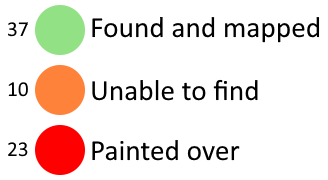
I’ve uploaded all the files I used for this project here. I used a spreadsheet to track my progress, the file is called “StreetSmArts_Murals_progress.ods”. You can find way IDs in column Q and notes in column S. This legend explains what each colour used in the spreadsheet means and how many murals belong in each category. Legend to explain each of the colours used in the spreadsheet along with how many murals belong to each category. Green (37 murals) means found and mapped, orange (10 murals) means unable to find and red (23 murals) means the mural was painted over. If you are unable to see this legend you may be looking at an archive of this diary entry, please go to https://ia902608.us.archive.org/24/items/Importing-StreetSmArts-Murals-in-San-Francisco/legend.png to find the image.

Tagging Schemes

There weren’t any tags for some of the information in this dataset so I came up with some new tags in the process.

Cultural Districts

Some of these murals are within certain Cultural Districts, which from what I’ve read on their websites are basically just a fancier version of neighborhoods that organize events to celebrate the culture of those within the district.

See full entry

Location: Civic Center, South of Market, San Francisco, California, 94102, United States

Hello!

I’ll be working on developing Python bindings for the OSRM project for GSoC this year.

I’m pretty excited to say the least, as mapping/navigational data is something that I find genuinely fascinating and important, but also because I’ll be able to learn about working on a project via hands-on experience - with guidance from some really nice mentors.

A little bit about me - I’m most comfortable writing C++ code, as it’s the language I have used the most by far. That said, I’m also interested in all things development related, so it’ll be a good opportunity for me to learn more about bindings and the Python side of things.

Posted by JM-Lemmi on 5 June 2023 in English.

Mapping the Weinsberger Berge

Inspired by Tom7 to go outside more, I set myself the goal of biking every Forestpath between Weinsberg and Heilbronn, before I will be moving avay in the Summer.

In the process I stumbled across many Tracks that need updating. Many have overgrown to the point of unusability, others are not mapped yet. One of the biggest challenges for the Forest in my opinion is deciding which Harvester Tracks should be mapped and which not. On a normal Field you wouldnt map every Tracktor Track, but in the Forest these Paths sometimes turn into paths used by the public. They are pretty volatile though. In the tree felling season they look like high traffic Tracks, very compacted, traversible by normal Trucks. But they are also not maintained, so quick to overgrow and turn very muddy to barely passable with a bike after a few days of rain.

This weekend I was able to complete the 4th of my areas and I wanted to take stock. I have driven every Path between Donnbronner Landstraße, Heilbronn and L1111. This includes the Schweinsberg, the vineyards, Köpfertal and Büchelberg. I also drove every path in Weinsberger Tal and the Waldheide between Donnbronner Landstraße, A81 and the Verwaltungsgrenze Weinsberg in the South.

See full entry

Location: Kernstadt, Heilbronn, Baden-Württemberg, Germany
Posted by Jan Olieslagers on 3 June 2023 in English.

Contrary to common practice, I hold (after much deliberation and consideration) that the best way to map runways is to make them an area.

One reason is that everybody and their dog, including our very own dearest wiki, defines a runway as being an area, with various elaboration. Example from our own wiki: [quote]A runway is a defined rectangular area on a land aerodrome (aeroway=aerodrome) prepared for the landing and take-off of aeroplanes. [/quote].

The eternal counter-argument is the parallelism to ways, railways, waterways and perhaps more; but I hold this argument to be non-valid. Unlike all the other categories, runways can NOT be joined to create routes. An aviator’s route planning mentions aerodromes and optionally other waypoints, navaids, visual reference points, but never runways. So that there is really no point in defining a runway as a way, or any other linear element.

I therefore strongly oppose both the mapping of runways as linear elements, and the additional use of area:runway or any such. The latter are totally redundant, and thus a waste of valuable resouces, storage capacity in the first place.

I am not the only mapper with this opinion, even less am I the first; many French ultralight terrains and their runways (“Base ULM”) have been mapped this way, and never been questioned. I find them perfectly satisfactory, too. For just one example among many, see [url] osm.org/way/587820283 [/url]

What is Hasiru Aqua & what do they do?

Hasiru Aqua, a leading agritech startup, is transforming the aquaculture landscape by providing vital support to farmers in Karnataka, India. Their efforts in increasing fish yields have significantly boosted farmers’ incomes and improved the overall socio-economic well-being of farming communities. Additionally, by incorporating fish into local diets, Hasiru Aqua is enhancing the health outcomes of individuals.

Hasiru Aqua 1

Why does Hasiru Aqua require mapping?

See full entry

Hello everyone, myself Neelima Mohanty , currently pursuing my BTech in Computer Science and Engineering from Odisha University of Technology and Research , Bhubaneswar , Odisha , India. I am a Sophomore (2nd year) . I have been selected as an Outreachy intern at Humanitarian OpenStreetMap Team (HOTOSM) for the May to August Cohort.

My Core Values which motivated me to apply to Outreachy

* Learning and Implementation

Once Benjamin Franklin had said “Tell me and I forget, teach me and I may remember, involve me and I learn.” Almost all the tech skills that I have learnt till date have implementations tied along with them. My internships , trainings and small projects are all evidences of the fact that I believe in a continuous and comprehensive process of learning and implementation. I applied to Outreachy on the same ray of hope that each time I make a contribution I will learn something new and implement it.

* Transparency

Quoting the line of Dalai Lama “A lack of transparency results in distrust and a deep sense of insecurity.” I always like the workplaces which are transparent and where the process of judgement is crystal clear . Such a place is Outreachy and also the organisation I had applied for (HOTOSM) along with my mentors Petya Kangalova and Rob Savoye. The three steps of Outreachy Open Source program – initial application , contribution period with final application and the internship period shows how Outreachy follows transparency and this really impressed me.

* Teamwork

“Teamwork makes the dream work” said by Bang Gae. During the contribution period of Outreachy , I came across my amazing mentors Petya Kangalova and Rob Savoye who guided me along every step and are still guiding me. Talking to them I felt like if I get selected , we will form a great team together. And here I am with me dream fulfilled.

See full entry

Posted by DLTQ on 1 June 2023 in English.

Last week, I became actively involved in Engineers Without Borders here in Norway, and a project that I was asked to engage with is “missing maps”.

Today, I attended a “mapathon” here in Oslo, I created my account here, and I made my first set of edits on this project: https://tasks.hotosm.org/projects/14389#description

I am starting out, but I hope that I can do some good work here in the future, and also invite others in as mappers, as well as organize my own “mapathon”.

Also hoping to join a community of mappers where we can exchange tips and tricks, and share best practices.

Best regards from Oslo, Raymond M. Kristiansen AKA “DLTQ”

Location: Tullin, Sentrum, Oslo, 0164, Norway

The OpenStreetMap (OSM) project has over 10 million registered members, with around 2 million user profiles having made at least one map contribution. However, a closer look reveals that there has been a slight decline in the number of active contributors over the last three years. Despite the extensive global mapping community, there are instances where individuals or automated bots disregard the consensus norms of the community when editing data. These situations arise due to disagreements regarding the appropriateness of certain tagging or features within the OSM database. To address these issues, a change rollback process, commonly referred to as reverting, is used to combat vandalism and correct ‘mistakes’ by restoring a previous version of the data.

Two years ago, I added additional statistics to the “How did you contribute to OSM?” page for quality assurance purposes. The numbers for each contributor profile were derived from an analysis of the full history OSM planet dump and changeset tags, including the specific editor used. While this pragmatic approach provides valuable insights, it’s important to acknowledge that the obtained numbers are estimations rather than exact figures. Furthermore, I received several inquiries regarding the implementation of the processing involved in identifying the displayed “reverted changes”.

Over the past few weeks, I have developed an advanced processing pipeline. This involved revisiting the comprehensive OSM planet dump and examining the evolution of each entity (node, way, relation) in relation to its previous states. Specifically, an entity with a higher version number was identified as a revert if it had the same latitude/longitude coordinates (for nodes), tags (key-value pairs), and/or members (for relations) as a previous version. In simpler terms, if a mapper changed “X” to “Y” and another mapper subsequently altered it back to “X”, it would be counted as a revert.

See full entry

Location: Ciutat de les Arts i de les Ciències, Quatre Carreres, Valencia, Comarca de València, Valencia, Valencian Community, Spain
Posted by nickjohnston on 31 May 2023 in English. Last updated on 14 February 2024.

Cheltenham is a town of 116,000 people in south-west England. During the Covid-19 pandemic lockdowns, I spent lots of time collecting addresses in the town and adding them to the map.

Cheltenham is now better mapped than parts of London and many other cities and towns. If I can do it, you can do it too—and better still, you can learn from my experience and mistakes.

Why?

Address coverage in OpenStreetMap is still poor in many places. Good coverage is needed for better geocoding, which many users view as an integral part of a modern map.

During lockdown, many people relied on deliveries. Even now, a huge amount of time is wasted not so much in “last mile” delivery issues but “last few hundred metres” ones.

UK address data is not open, so addresses have to be surveyed or collected on the ground. This is tedious and repetitive, but there are some upsides. You’ll uncover mistakes in places which haven’t been touched on OpenStreetMap for years, and you’ll have the opportunity to improve geometry and alignment with the far better imagery now available.

Walking around your town or city is a great way of discovering new places and learning more about local history. Like many people, I’d heard of the mass trespass of Kinder Scout and how it ultimately led to greater access to the countryside. But I was unaware of earlier agitations here in Cheltenham over access to Leckhampton Hill. The hill is now part of the Cotswold Area of Outstanding Natural Beauty, crossed by the Cotswold Way National Trail which passes a memorial tree for one of the rioters.

Approach

I started collecting addresses in earnest in mid-April 2020, continuing to August 2021. I collected addresses at least once per week but usually more. I’d walk for anywhere from 30 minutes to four hours at a time.

See full entry

Location: Sandford, Fairview, Cheltenham, Gloucestershire, England, GL53 7HZ, United Kingdom
Posted by zabop on 30 May 2023 in English. Last updated on 3 July 2023.

These notes are primarily written for my future self (to prevent having to figure out things I have already figured out once).


Oslo has a great City Bike system. There are over 200 stations where one can pick up or return a bike (map), for the yearly fee of a few lunches.

I would like to see if some of these stations are missing from OpenStreetMap. I will be looking for the amenity=bicycle_rental tag. I get an OSM extract from GeoFabrik:

curl https://download.geofabrik.de/europe/norway-latest.osm.pbf -o norway-latest.osm.pbf

Using this gis.SE answer, I know I a modified version of osmconf.ini would help me query the amenity class. I create bysykkel_osm.ini:

See full entry

Location: Akershus festning, Sentrum, Oslo, 0015, Norway
Posted by miku0 on 30 May 2023 in English.

Hello!

Hi everyone!

My name is Miku, and I’m currently a master’s student at Tokyo University of Science in Japan. During my free time, I enjoy watching anime and reading books. I’m incredibly excited about the opportunity to contribute to OSM community!

What I will do?

My project involves developing the search experience in Japan, which has a unique address system. Nominatim, the geographic search engine of OSM is using tags ‘addr:street’ and ‘addr:place’. However, the Japanese address system does not have the same system of these specific categories. Consequently, searching for addresses in Japan becomes challenging. My primary focus will be on addressing this issue with the Japanese block number address system by developing sanitizer and tokenizer.

Here are the milestones for my project:

  1. Develop a sanitizer capable of properly setting tags for Japanese specific components such as housenumber, block_number, and neighbourhood
  2. Implement a tokenizer that can generate appropriate formats based on the Japanese address structure
  3. (Optional) Add functionality to the tokenizer to differentiate between Chinese characters and Japanese characters Thank you for taking the time to read my introduction! I am eager to collaborate with everyone in this community. These problems are closely related to Japanese localization, and this is my Japanese introductory page. If you have any questions, please feel free to ask them in the comments!