 OpenStreetMap

On the search for some nice curvy roads. Found some decent ones. SR 424 seems lovely. Next time up I want to go to the Whitefish Ski Resort area before it gets too busy in winter. Not sure if I’ll go there or Ashley Lake next, but it’ll be one of the two. Might knock out both at the same time.
Diary Entries in English
Recent diary entries

I discovered OSM some time ago… Currently I try to learn every time I can a few things new on it. By trying and trying, for example it is now that I discover the diary section😎
It is both fun and useful since we contribute to a good initiative while having fun.

I thought for quite a few days on the Jochen’s study for the OSM data model, and I’ve no idea on whether it’s good or bad or how to improve it. The process feels pretty straightforward to me.
But that’s the issue. It’s not impossible. To fix OSM data issues, changing the data model is not important. Frankly, I don’t have anything to add to my 2019 talk at Heidelberg. It was a reply to Jochen’s and Andy’s musings on API 0.7 back then, and it is still now.

OSM Africa Monthly Mapathon is an initiative to support OpenStreetMap community development in Africa. The aim is to bring OSM communities across Africa together to learn from each other, network, and grow the spirit of collaboration while contributing data to OpenStreetMap.
Posted by pedrito1414 on 2 September 2022 in English.

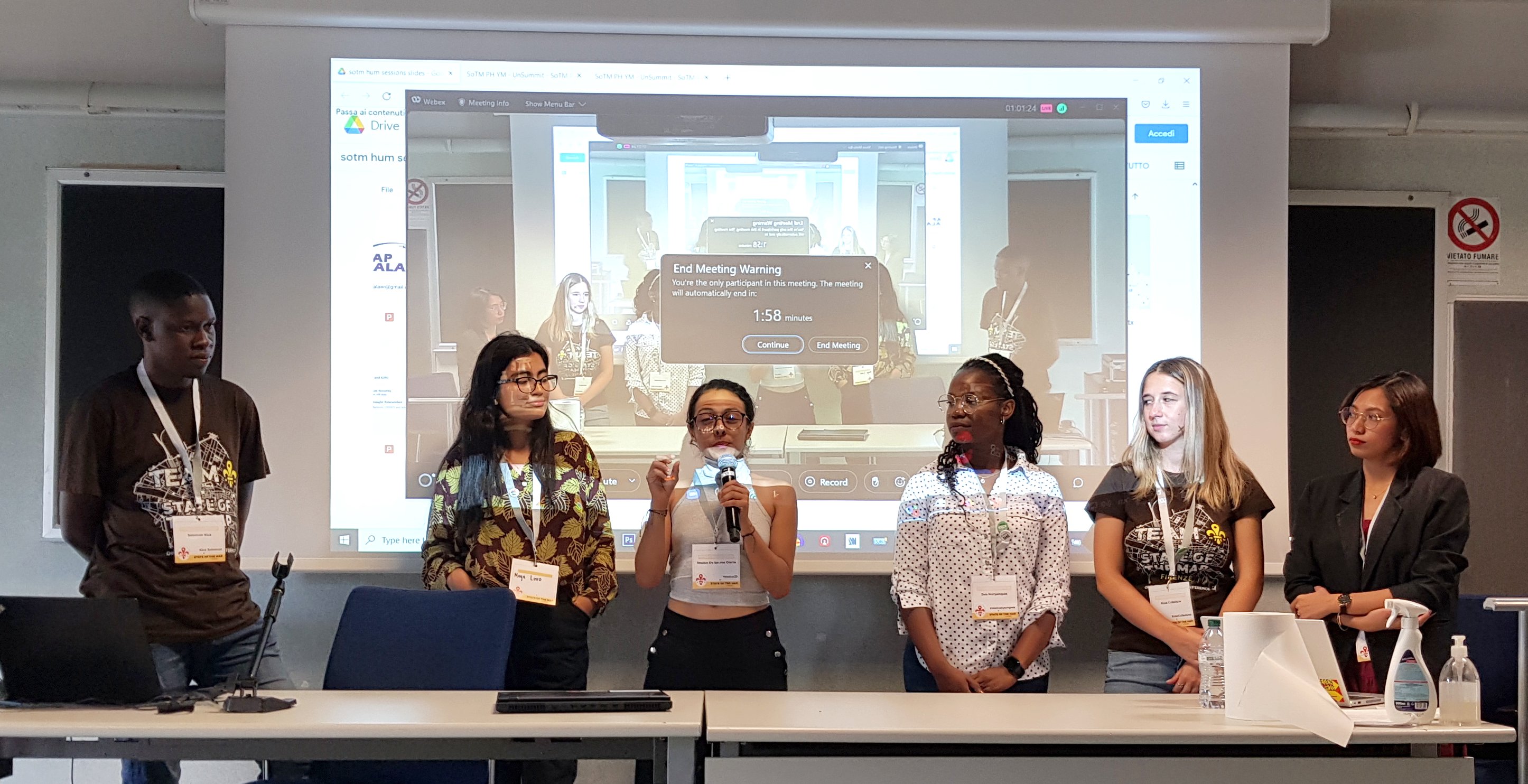
Inspired by Gustavo’s diary on his SotM experience, I am putting some of my thoughts down on paper…
This was only my second in-person State of the Map (first in Belgium) but it felt like I’d been many times - people were so welcoming and open, the organisation and volunteers were great and there were a lot of familiar faces (and usernames).
On Friday my main track highlights were Martijn on 10 years of MapRoulette and Kristen on Entry Level Mobile Mapping.
On the Friday afternoon (also World Humanitarian Day), I hosted the HOT unSummit Humanitarian sessions (which you can watch again here) and we heard fantastic stories and insights and saw some great maps, data and tools from 12 different speakers, all relevant to humanitarian open mapping and from all corners of the world. Kudos to the speakers for being so well prepared and to the audience for being so engaged and curious. It was a really great afternoon.
utilsplugin
- must have plugin
- provides several useful tools for faster and more efficient editing in JOSM
- e.g. "Split objects" by pressing "Alt"+"x" as an alternative to the terracer plugin in case of more complex shapes
- more info: https://josm.openstreetmap.de/wiki/Help/Plugin/UtilsPlugin2
Buildings_tool
- must have plugin
- press "b" to activate the plugin
- rectangular buildings can be created with just two mouse clicks if another object is selected as guide for orientation
- if no other object is selected, three mouse clicks are required
- tag "building=yes" is inserted automatically
- pressing "CTRL" deactives auto-snapping. This is required to avoid that the new building has shared nodes with highways
- choosing a node of an existing building as first node offers the possibility to align the new building to the one already existing.
- more information: osm.wiki/JOSM/Plugins/BuildingsTools
HouseNumberTaggingTool
- used to assign house numbers to ways or nodes
- simply select an object and press "k" on the keyboard to open a window with common address keys
- if (downloaded) objects in the vicinity have already assigned keys like "addr:street" or "addr:postcode" these values can be easily selection from a drop-down list. This avoids false edits.
- tool allows to automatically apply increments to house numbers every time a new house number is assigned (increment slider at the bottom of the window)
- more info: https://josm.openstreetmap.de/wiki/Help/Plugin/HouseNumberTaggingTool
Terracer
Posted by Gustavo22Soares on 31 August 2022 in English.

Posted by Socredelir on 31 August 2022 in English.
Last updated on 1 September 2022.
More than 5 mysterious building sites were found in Kissidougou district, Guinea, where the satellite maps show only forest.
These sites were crowded each with more than 30 buildings, each are squares with size about 100x30 m. It is very clear to be seen when we take a look at the OpenTopomap in the north and the east of Kissidougou city, where these buildings are rendered as a lot of big black spots.
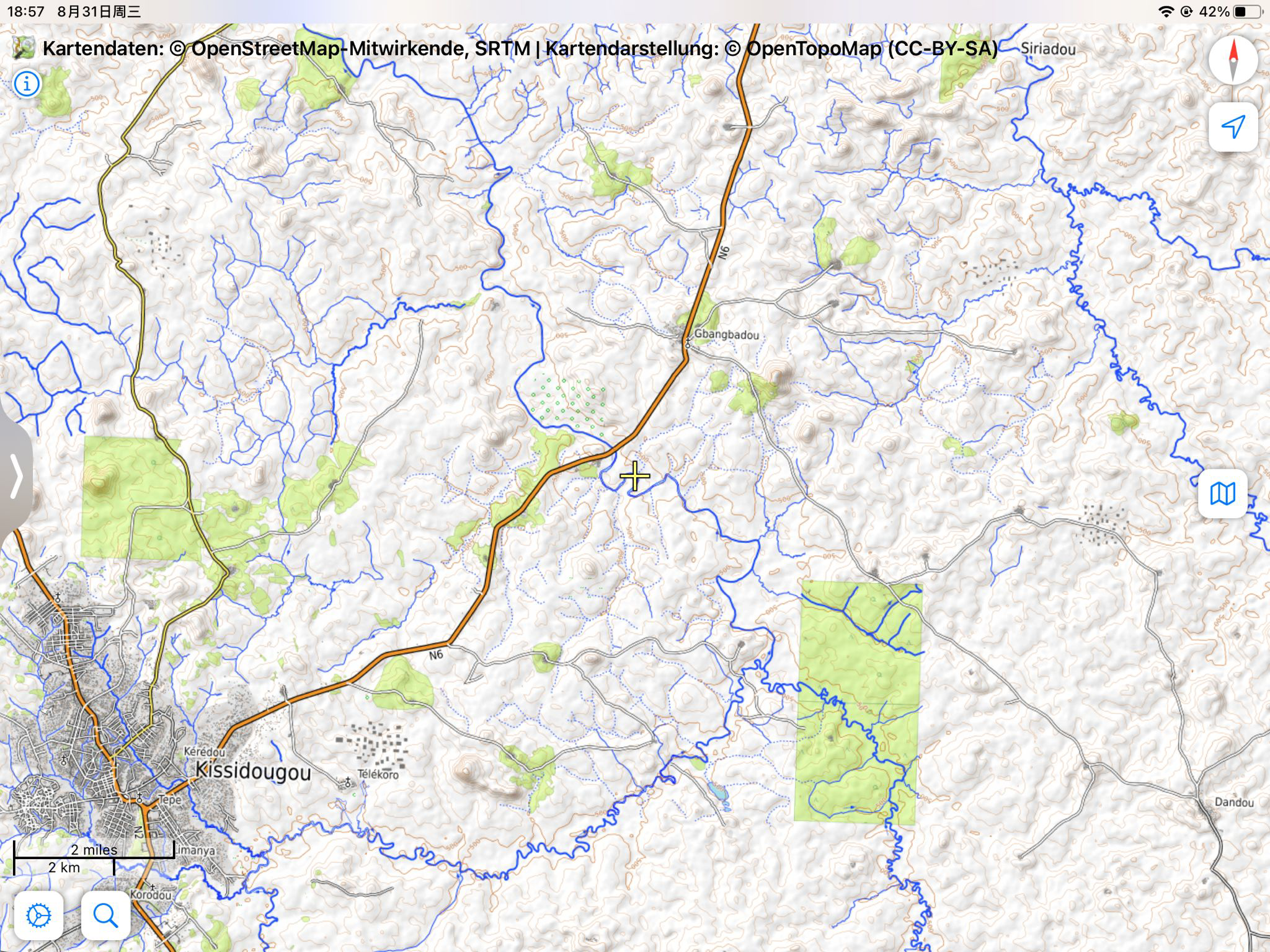
The position marked in the article is only one typical example among them: osm.org/#map=15/9.2019/-10.0495
Posted by radiotrefoil on 31 August 2022 in English.
Last updated on 9 March 2024.

Introduction
Taking open-source street-level imagery is a productive and fulfilling way to make a lasting contribution to OpenStreetMap. Typically, amateur street-level imagery uploaded to platforms such as Mapillary and Kartaview consists mainly of images scraped from dashcam footage, or from a handheld smartphone. To a lesser degree, some 360 imagery is also taken. Whilst these are valuable, many street-level imagery sequences suffer from various drawbacks including poor resolution and spatial accuracy, motion blur and narrow field of view. Generally the imagery compares poorly to proprietary alternatives that cannot be used for OSM. In this post I propose a fairly low-budget option for 360 street level imagery that has led to satisfying results. The results are comparible to roughly 1st-2nd generation Google Streetview (circa 2010) and is far better than TomTom/Bing Streetside imagery in Australia.
In this post, GPS refers to geopositioning in general through GNSS, rather than the US satellite constellation.
This post is written from Australian perspective using Android/Windows, so results may vary.
By “affordable” I mean <$1000 AUD. My total expenditure on this project was $700-800 AUD, so that may be inaccessible to some.
I am likely to update this post in the near future as the project continues. Please check back here regularly if you are interested, and feel free to reach out on OSM or the OSM World Discord server.
Camera selection
Posted by Adedewe Abiodun on 31 August 2022 in English.
On this day, I participated in Unique Mappers OSM Nigeria, a monthly Mapathon. It was so exciting to have everyone joining from different part of Nigeria and beyound. I look forward in few weeks ahead when Etsako east would be completely mapped to provide open map and data for humanitarian use.

Today I participated in Unique Mappers OSM Nigeria monthly Mapathon during which I facilitated the mapathon and providing training to newbies in the beginners room. It was so exciting to have everyone joining from diffrerent parts of Nigeria and beyond ,including Germany and Tanzania. We look look forward in the few weeks ahead Etsako east project would be completely mapped to provide open map data to drive humanitarian response and social good project
Posted by JanetChapman on 28 August 2022 in English.

It was wonderful, if slightly overwhelming and sometimes surreal to finally meet so many fellow mappers again at SOTM Firenze last week, as well as so many new friends that I’d only interacted with online. This was my 4th in person event and it reinforced not only how much Crowd2Map has grown since Brussels 2016 but also how the mapping community has changed.
In 2016 arrived in Brussels late at night, a bit disconcerted to find that I was sharing a bed with a stranger - Miriam from GeoChicas. We quickly got over this surprise and she became a great friend and ally, even visiting the FGM Safe Houses we work with in Tanzania en route to FOSS4G 2018. In Brussels I was a newcomer who knew no one. I tried to navigate the seeming chasm between the brown shirted craft mapper gang and the humanitarian team. In Firenze I was very pleased to note much less of this divide. Arriving felt like coming home after a long journey, meeting so many people from previous events and others for the first time IRL.
Particular highlights for me were talking about the impact of our Digital Champion project, meeting colleagues from Missing Maps HOT and Youthmappers who I’d only interacted with online. Kristen Tonga’s talk on the challenges of mobile mapping in rural Tanzania really resonated with our experiences setting up our Digital Champions program, and we look forwards to working with her going forwards.
Ilya is always enthusiastically working on something interesting and this year was no exception, we’re looking forwards to working with him on Every Door soon. The We’re also looking forward
We were particular proud that Binyam Dele Youthmapper Ambassador from Ethiopia wants to replicate our work fighting FGM there.
Greatly looking forward to next meet up - particularly State of the Map Tanzania in January 2023 and hope to see many of the mapping community there either in person or online!
Posted by radiotrefoil on 28 August 2022 in English.
Last updated on 26 June 2025.
The following is an incomplete list of 360 camera sequence examples by model on Mapillary, along with some comments, with respect to the image quality and price of the camera. This will be an ongoing work in progress.
| Camera | Example | Comments |
|---|---|---|
| GoPro Fusion | Radiotrefoil | Image clarity much worse near stitch line between hemispheres but overall quite good |
| GoPro Max | 360ms; ademturkmen | Very similar performance to Fusion |
| NCTECH LTD iSTAR Pulsar | zaf3kala | Professional quality 11K spherical images, price unknown but assumed to be very high |
| LG Electronics LG-R105 | yoelt | Cheap option, offers OK results but a lot of text illegibile |
| HUAWEI VOG-L29 | lehestener | Invalid spherical image? |
| Insta360 One X2 | jkingsleya | Image quality doesn’t justify price of camera |
| Ricoh Theta SC | adam2 | |
| MADV/Xiaomi Madventure | gness | |
| Garmin VIRB 360 | max93600 |
Please feel free to help me add to this list and share your insights using the Google sheets link below. https://docs.google.com/spreadsheets/d/1ajTm_0fRKLHiGJS2TW0CNscbW4NItuyjkJxzU_kbLXg/edit?usp=sharing
The Mapillary GraphQL API can access metadata for camera make/model, however it is an undocumented feature and lately I have been getting “access denied” error even when using my API token. If anyone knows a workaround please comment.
Some times I feel like I’m the only person who really gets me. I don’t have friends, but a mother that is our of this world. I want to explore this
I was preparing a video tutorial about stiles (online tomorrow morning on my channel). Even though I have mapped quite a few stiles while hiking, I came to the realization that I had mapped a lot of them wrong (mostly using OSMAnd, where I have to remember a lot of tags, bc they’re not presets) after reading the wiki page barrier=stile. Oops. While reading the page, it occurred to me that it was a bit messy, so I tried to tidy it up a bit and tried to find some examples for such cases that are a bit tricky to decide, like the stepover. I had tagged some of those as ladder, because they included more than one step.
I also took a look at the taginfo for the stile values, and boy, was there chaos! I mean, we’re mostly all humans, so we make mistakes and typos which might then be propagated through auto-text in JOSM or copying and pasting, who knows. I actually found one mistake I made myself this way. Some were obvious typos (steover) that I could correct without having visited the site, for others, I contacted the person who had added them (sometimes as far back as 8 years ago, so they couldn’t remember, and just had to delete the stile=* line, unfortunately).
But I also looked at commonly used ones like hipster and added explanations to the wiki page. Two I had to translate into English, and I hope I did it correctly, because they were both in languages I don’t speak, so I used image search to figure out what could be meant. I reduced the list from 4 pages of values to 2.5, so it’s a bit tidier now.

I’m sure some of you have heard of a map that shows the locations of AEDs in Poland, available at https://aed.openstreetmap.org.pl. Thanks to community activism and a campaign among local government units, more than 3,000 device locations have been introduced. Encouraged by the success of the Polish map, we were then tempted to expand the project’s area of operation to increase community involvement in inputting AED device data into the OpenStreetMap database.
Currently, two members of the OSMP organisation tomczk and starsep are attempting to rewrite the existing version of the website using React technology and implement new functionalities. Their results to date are now available at https://openaedmap.org.
The website will be continuously developing. We would like to prepare websites with statistics broken down by country and make it possible to download data in the same way as in the Polish version of the website. The Colleagues are also working on improving and extending the form to allow not only the addition of device data from the page, but also editing.
Our dream is to expand the functionality with the ability to add photos of devices in order to verify them and make it easier to find them in the field. For which we do not have the technical resources at the moment, but hopefully we can acquire a technology partner to help us with this.
Unfortunately, due to the amount of work this project requires, we need Your help. If you have skills in the following areas please email us at: aed@openstreetmap.pl
We need volunteers to support us with their React.js (front-end) and Python scripting skills, and because of the international character of the project we also need help with translations into languages other than English, with priority for French, Ukrainian, German and Spanish.
The Polish version of this entry is available at: OSMP page

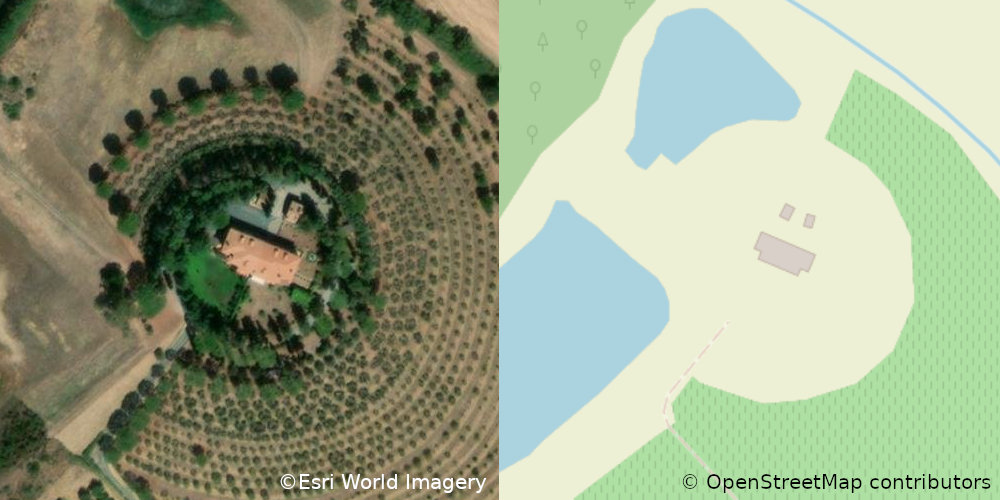
It’s not vandalism, but just a funny case of Pareidolia.
The location is near Castiglione della Pescaia, Tuscany, Italy.

At long last, I’ve done a complete pass over municipal and CDP
boundaries in New York State. Barring errors and omissions (I
daresay there must be some) every incorporated community and every
CDP in the state has had its border checked against NYSGIS
Civil Division Boundaries and TIGER/Line 2021 respectively, almost
always resolving conflicts in favour of the former.
All have place=* nodes representing them, with the node a label
member of the boundary relation.
Populations are updated as of the 2020 Census. GNIS, FIPS, NYS SWIS, Wikipedia and Wikidata links are provided.
Most of the remaining work that I’d have to do before I consider
the job to be done has to do with the tagging on the place=* nodes.
Right now, they’re a hodgepodge. Most of them came in from the TIGER
import of 2008 with place=* representing their form of government.
This is NOT an indication of the significance of the place.
Brentwood, Long Island, a bustling community of over 60,000 souls,
is tagged place=hamlet because it does not have home rule.
Geneva, a sleepy lakefront village is 3400 inhabitants or so,
is tagged place=city because it has a city charter.
For a first stratification, I’d propose simple thresholding on population:

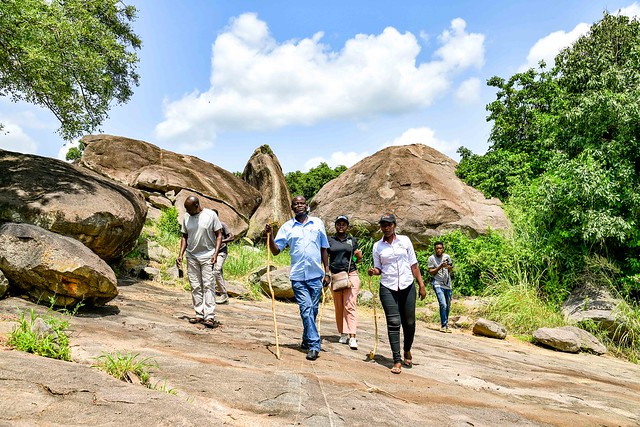 Baker’s Fort Patiko- Gulu District,Uganda
For the rest of the year I will be working on railways. I will use references from various sources to verify my work.
Start AUG 20 2022
End DEC 31 2022
Sponsored By: None this time.